Cardano (ADA) Price Moves: 36 Flagged, 0 Reversed
A Coin That Kept Its Word Thirty-Six Times
Picture a coin that lurches hard enough to make people sit up, thirty-six separate times across the better part of three months, and never once takes it back the next day. That is not the usual arc. The usual arc has a twist in the third act.
Cardano didn't write a third act.
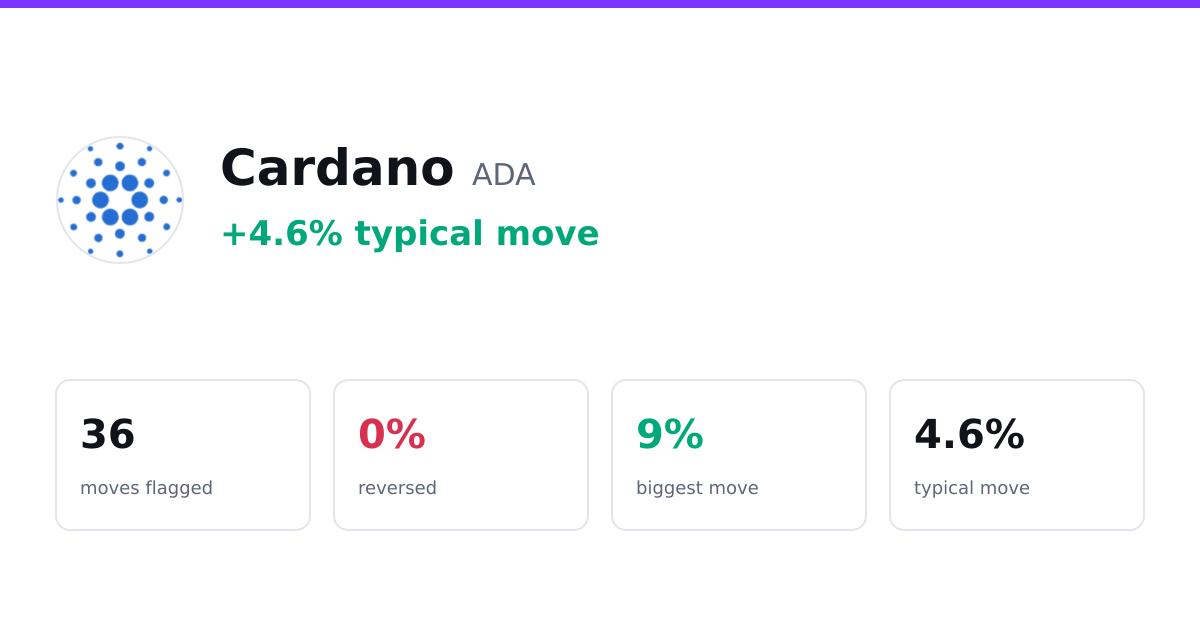
Between June 5 and August 26, 2026, ADA tripped the wire for an unusual move thirty-six times. A day later, the number that had reversed was zero. Not a small fraction, not a couple of second thoughts. Zero.
That is the kind of clean sheet you double-check, because markets do not usually hand them out. A big move is supposed to invite a correction. Somebody rushes in, somebody rushes back out, and the candle that looked so decisive at noon is quietly apologizing by the following afternoon. Cardano ran the table without that apology showing up even once.
Nineteen Up, Seventeen Down, All Standing
The moves themselves were not monsters. The typical flagged move on ADA came in around 4.6 percent, enough to notice, not enough to write home about. The biggest of the whole run reached 9 percent, which is a respectable jolt but a long way from the vertical stuff that gets screenshotted and passed between group chats.
So this is not a story about size. It is a story about consistency.
The direction split almost down the middle. Of the thirty-six flagged moves, 19 were rallies and 17 were sell-offs. Cardano climbed and Cardano dropped in roughly equal measure, which means whatever discipline was on display here did not depend on the wind blowing one way. Green moves held. Red moves held. The market pushed ADA up, ADA stayed up. The market shoved it down, it stayed down.
*Previously: Holoworld's Green Candle Was A Trapdoor In Disguise*
There is something almost stubborn about it. Most coins, when they move hard, are bluffing about half the time. Cardano moved hard three dozen times and meant it every single time, at least by the measure that matters here, which is where the price actually sat one day later.
Why Zero Is The Number That Raises An Eyebrow
Here is the context that makes a clean sheet interesting rather than just tidy.
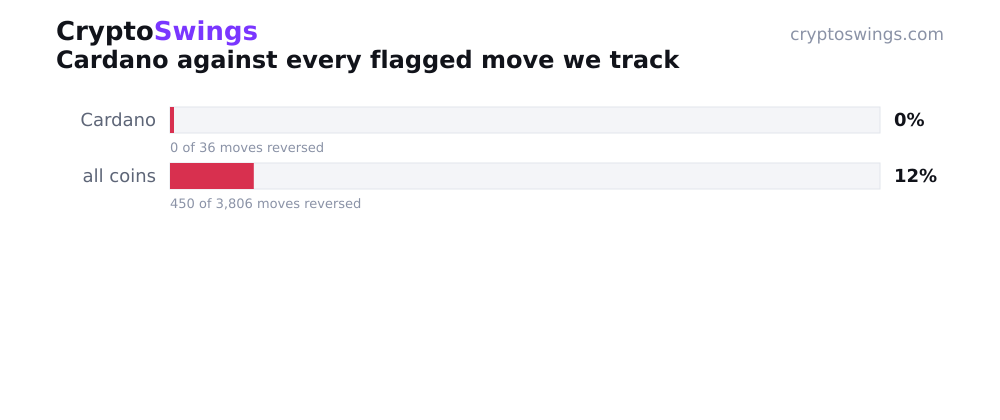
Across every coin being tracked, the average reversal rate sits at 11.8 percent. That is the baseline hum of the market, roughly one in every eight or nine flagged moves changes its mind within a day and gives back the story it told. It is the background rate of buyer's remorse, priced in.
Cardano's rate is 0 percent.
Thirty-six chances to fake it, and Cardano took none of them.
Now, ADA is a large, heavily traded name, and bigger coins tend to be a little steadier than the small-cap fireworks that spike on a whisper and unwind on a shrug. A large coin sitting below the market-wide reversal rate would be unremarkable. Sitting at exactly zero across a sample this size is a different animal. It means that over eleven weeks, no matter which way the move went, the follow-through was there. The coin behaved less like a lottery ticket and more like a coin that does what its price action advertises.
Whether that holds forever is a separate question. What the record shows is a stretch where it held completely.
What Counts As A Move, And How We Know It Stuck
A quick word on the plumbing, because a clean number is only as good as the way you got it.
Every figure here comes from moves that were flagged automatically, the system watches for price action unusual enough to stand out from a coin's normal chop, and marks it. That is the setup. The verdict comes later. The outcome of each flagged move is measured against the real market price one day later. If the move held its ground, it counts as holding. If the price snapped back the other way, it counts as a reversal.
No opinions in that pipeline. No mood, no read of the room, no forecast about what should happen next. Just: something unusual happened, and here is where the price actually landed a day afterward. The reversal count is simply the tally of moves that undid themselves against that later price.
For Cardano, that tally came back empty. Thirty-six flags in, zero reversals out.
Did Cardano (ADA) Reverse Any Of Its Flagged Moves?
Straight to the question a lot of people are actually typing: did Cardano reverse any of its flagged moves?
No, across 36 unusual moves flagged between June 5 and August 26, 2026, ADA reversed zero of them, for a reversal rate of 0 percent.
That is the whole answer, and it holds up in both directions. The rallies that got flagged did not fold. The sell-offs that got flagged did not bounce back. Against the 11.8 percent reversal rate that applies to the full field of tracked coins, Cardano didn't just come in low. It came in at nothing.
If you were looking for the coin that spent this window quietly doing exactly what it looked like it was doing, this is it. A 9 percent top-end jolt, a 4.6 percent typical nudge, nineteen climbs, seventeen slides, and not a single one of them taken back the next day.
The Fine Print A Clean Number Deserves
Now the part where we keep ourselves honest, because a zero this clean can start to feel like a promise, and it is not one.
This is a record, not a road map. Everything above describes moves that already happened inside a fixed window, June 5 to August 26, 2026. It does not say what ADA will do next week, next month, or the next time it lurches. A coin can go eleven weeks without reversing a single flagged move and then reverse the very next one. The zero is a description of a stretch that closed on August 26. It is not a guarantee that stretches into the future.
The window itself is a limit too. Widen it, or shift it earlier or later, and the picture could soften. Thirty-six moves is a solid sample, enough to make a clean sheet meaningful, but it is still a slice of one coin's life over one particular season of the market. Another season might tell a different story.
And the measurement has a horizon baked in. Each outcome is checked one day later, not an hour later, not a week later. A move that held for a day and then unwound on day three would still count here as holding, because the check happens where it happens. So "did not reverse" means "did not reverse against the price one day out." That is the specific thing this data can see, and the only thing it claims to.
What would change the read? A longer window that caught more of ADA's behavior. A rougher patch that finally cracked the streak. More flagged moves that let a reversal or two creep in and nudge that clean zero off its zero. Any of those could move the number. Right now, none of them have.
For eleven weeks, across thirty-six flags, up and down and back again, Cardano said what it meant and meant what it said. In a market where roughly one flagged move in eight quietly takes it back, that is a genuinely unusual thing to be able to write down, a coin that, for this stretch at least, never blinked.