Does a Loud Spike Hold Better Than a Quiet One?
The Question Every Trader Argues About at 2 A.M.
Here is a belief so common it barely gets questioned: a spike backed by heavy volume is a real spike. A move with a crowd behind it means something. A quiet drift up on thin volume is the one you distrust, because nobody's really committed and the whole thing can unwind before you've finished admiring it.
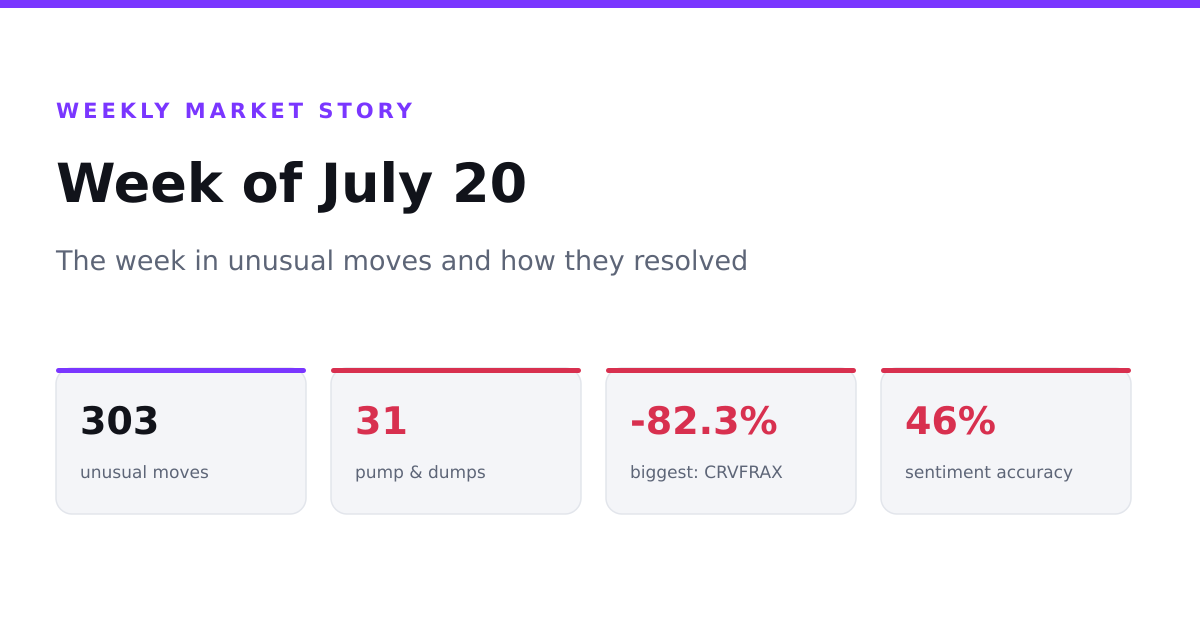
It sounds right. It has the texture of wisdom. And the week of July 20 to July 26, 2026 gave us 303 unusual moves to check it against, which is a large enough pile to say something other than a shrug.
So we sorted the week's spikes into two buckets. The loud ones, with real volume behind them. The quiet ones, without. Then we watched which ones actually held their ground by the time the tape went dark.
The Answer Nobody Ordered
Of the 169 loud moves, 31 percent held. Of the 134 quiet ones, 45 percent held.
Read that again, because it's the whole article in two numbers. The loud ones held less often than the quiet ones, which is exactly backwards from the folk wisdom. The crowd, the volume, the conviction you were supposed to trust turned out to be the worse tell.
Now the honest part, because a number without a caveat is just a rumor in a suit. This is one week. A hundred and sixty-nine loud moves and a hundred and thirty-four quiet ones is a real sample, not a toy, but it is not a law of physics. Run it again next week and the gap could narrow, widen, or flip. What it is not, on this evidence, is proof that loud means durable. If anything the week leaned the other way, and it leaned there with some enthusiasm.
There's a reason that makes intuitive sense once you stop fighting it. A loud spike is loud because a lot of people are trading it, and a lot of people trading a micro-cap all at once is frequently the sound of a pump filling up with the very sellers who will end it. The volume isn't conviction. Sometimes it's a countdown.
The Loudest Voice in the Room
Which brings us to the week's headliner, and the single clearest illustration of everything above.
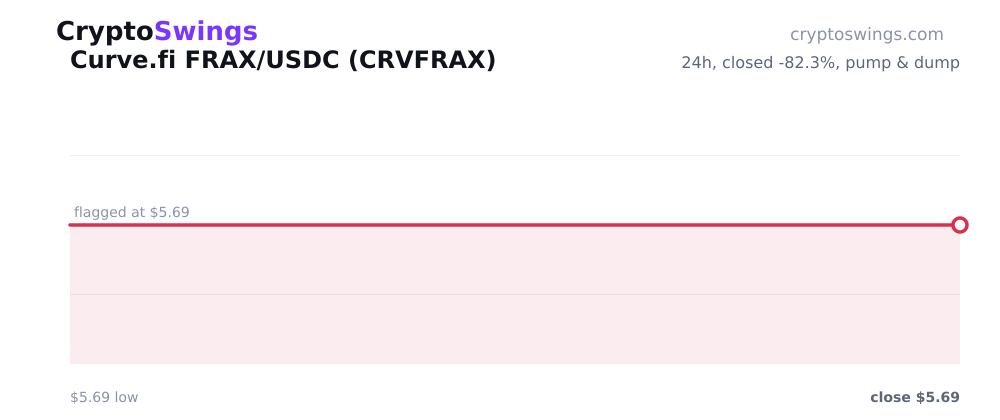
Curve.fi FRAX/USDC is a micro-cap that spent this week auditioning for a disaster movie. In about an hour it ran up 465.5 percent. That is not a rally. That is a vertical line with ambitions.
The setup was as loud as they come. Volume, attention, a chart doing the one thing that makes people forget every hard lesson they've ever learned. And the sentiment around it? Strongly bullish. The room saw the candle, felt the heat, and leaned in. The read was wrong.
Because the resolution was already loaded. From that towering peak the coin gave it all back and then some, closing the move down 82.3 percent. Nearly five-fold up, then more than four-fifths gone. A confirmed pump and dump, and one that hardly anyone saw coming before the floor opened.
It's the perfect specimen for the week's lesson. All that volume didn't hold the spike up. It's what made the spike possible, and then it's what walked out the door. The loudest move of the week was also one of the least durable, which is either an irony or a warning depending on whether you were holding.
The Rest of the Loud Ones Told the Same Story
CRVFRAX wasn't alone in getting the treatment. ROLL climbed 146.2 percent over a day and closed down 15.3 percent, though notably that one was not a pump and dump, just a spike that faded. Unitas doubled, up 101.9 percent, and finished down a mere 2.5 percent, close enough to breakeven to feel like a coin that ran a marathon and ended back at the starting line.
Normie jumped 94.2 percent in about an hour and closed down 26.5 percent. BENQI ran 73.1 percent, also in about an hour, and gave back 28.2 percent. Every one of these arrived with bullish or pump-suspecting sentiment attached, and in each case the crowd's read didn't survive the day.
Notice the pattern threading through the top of the board: every headline mover finished lower than where its spike detected. The week's biggest, loudest, most attention-grabbing moves were, almost to a coin, exits dressed up as entrances. And the week counted 31 confirmed pump and dumps in total, so CRVFRAX was the loud lead of a much larger chorus.
The traps ran deeper than the top line, too. Beyond CRVFRAX, MEET48 quietly slid 39.5 percent and o1.exchange dropped 32.4 percent, both of them the kind of move that hardly anyone flagged before it happened.
What the Week Is Actually Telling You
Across the whole seven days, community sentiment landed on the right side of things about 46 percent of the time, per the swing data tracked by CryptoSwings. That's a coin toss that lands wrong slightly more than it lands right, which fits the mood of a week where the obvious read kept getting punished.
So what does all this suggest about current conditions? Nothing about where the market goes next, because that's not a thing this data claims to know. But it does sketch a texture. This was a week where noise was not signal. Where the loudest spikes were the least trustworthy, where volume behaved less like conviction and more like a crowd gathering to watch something fall.
That's a market in a particular mood. Not a calm one, not a trending one, but a jumpy micro-cap tape where the sharpest-looking moves were built to reverse. The quiet spikes, the ones nobody was shouting about, actually held up better. There's a small, uncomfortable lesson buried in that, and it's the oldest one there is: the thing everybody's watching is often the thing everybody's about to be leaving.
One week doesn't overturn the folk wisdom. But it did lean on it hard, and the folk wisdom flinched.