Monero (XMR) Price Moves: 54 Flagged, 4 Reversed
The Coin That Stays Bought
Most of the market treats a sudden move like a dare. A coin jumps, the chart lights up, and half the time the move is already apologizing for itself before the candle closes. It is the ambient mood of the small end of the market: loud, twitchy, and allergic to follow-through.
Monero did not get that memo.
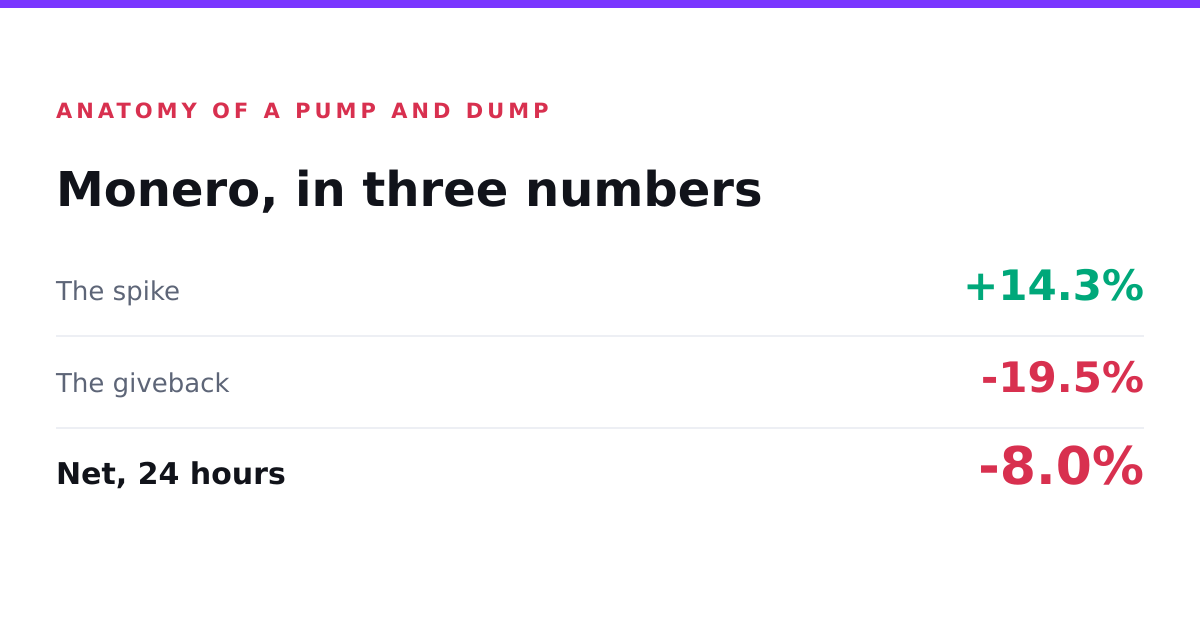
*Previously: Monero Climbed All Day, Then Lost Its Footing by 8%*
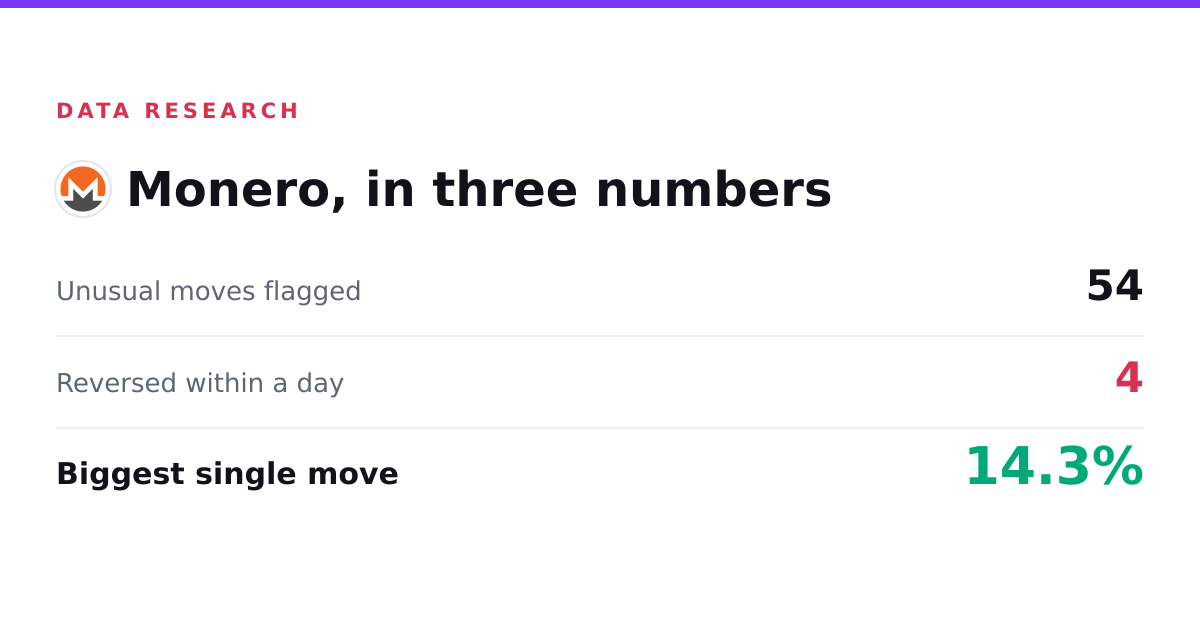
Between June 10 and October 11, 2026, the privacy coin known by the ticker XMR triggered 54 unusual moves. Of those 54, exactly four walked back on themselves within a day. Four. That is the kind of record that makes you double-check the column, because steadiness is not what this corner of the tape usually sells.
The Shape Of A XMR Move
So what does a Monero move actually look like when it decides to get interesting?
Modest, mostly. The typical flagged move came in around 4.5%. That is a real move, enough to register on a watchlist and enough to make a position breathe, but it is not the stuff of screaming headlines. Monero's drama is understated. It raises its voice, it does not break the furniture.
The biggest of the lot stretched to 14.3%. That is the ceiling across the whole four-month stretch, which tells you something all by itself. Plenty of micro-caps post a 14% day and treat it as a warm-up. For Monero, that number was the outlier, the single loudest it got. The rest clustered down near that 4.5% middle.
The directional split leans upward. Of the 54 flagged moves, 32 were rallies and 22 were sell-offs. So Monero spent a touch more of its noisy days climbing than falling, though not by a landslide. This is a coin that moves both ways and does not seem especially committed to either as a personality trait. It just goes, and then it mostly stays wherever it went.
Why Four Out Of Fifty-Four Is The Whole Story
Here is where Monero stops being merely tidy and starts being genuinely unusual.
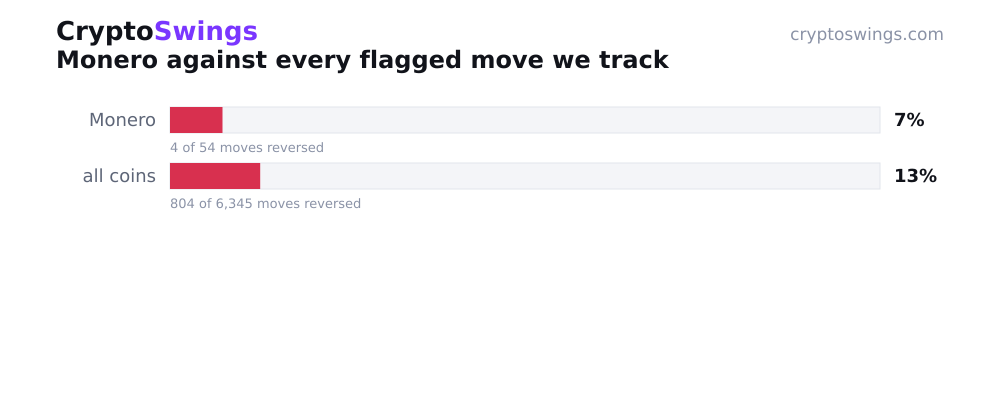
Four reversals out of 54 works out to a reversal rate of 7.4%. Across every coin tracked, the average reversal rate sits at 12.7%. So Monero reverses at a little over half the rate of the broad field. When it moves, it tends to mean it, and the follow-through holds up measurably better than the market norm.
That gap matters more than the raw count. A low reversal rate on three flagged moves is noise. A low reversal rate on 54 of them is a pattern with some weight behind it. Fifty-four is a decent sample, spread across four months, and the behavior stayed consistent enough to land well under the average. Monero did not just avoid reversing on a lucky week. It kept the habit.
The polite way to say it: most coins that get flagged are auditioning. Monero shows up, does the thing, and clocks out. There is a reason it reads as the quiet professional of the bunch, and it is sitting right there in that 7.4%.
What Counts As A Move Here
A word on the plumbing, because a number is only as honest as the method behind it.
Every figure in this study comes from unusual moves that were flagged automatically, not hand-picked after the fact. A move gets flagged when the price does something out of the ordinary for that coin, and then the outcome is checked against the real market price one day later. Did the move hold, or did it unwind? That is the entire test.
So a reversal here means something specific and plain: the coin made a notable move, and a day later the price had turned back on it. No interpretation, no mood reading. Just the move, and then the price one day on, measured against each other. When we say Monero reversed four times, we mean four flagged moves that failed to hold up a day later. The other 50 stuck.
It is a deliberately boring definition, and that is the point. You want the measuring stick to be dull so the results can be interesting.
Does Monero Reverse Its Moves Often?
If you came here asking whether Monero tends to give back its moves, the direct answer is no. It reversed on just 7.4% of its flagged moves, against a 12.7% average across all tracked coins.
That is roughly half the typical rate, over a 54-move sample that ran from early June through the middle of October. Translate it out of percentages and into plain English and you get this: when Monero got flagged, it held its ground the overwhelming majority of the time. Fifty of 54 moves were still standing a day later.
Compared to the twitchier residents of the tape, where this column spends most of its time documenting round trips to nowhere, Monero is refreshingly literal. A move was usually just a move. If you want the market's nervous energy, you go looking elsewhere, which, incidentally, is more or less the entire appeal of a project like CryptoSwings that catalogs where that energy actually lives. Monero, for its part, keeps its drama quota low and its follow-through high.
What The Numbers Will Not Tell You
Now the part where the data puts its hands up and admits what it does not know.
This is a record, not a crystal ball. Everything above describes what Monero already did between June 10 and October 11, 2026, and nothing in it forecasts the next move. A 7.4% reversal rate is a very good description of 54 past events. It is not a promise about the 55th. Markets are allowed to change their minds, and a coin with a tidy history can start unwinding its moves tomorrow without consulting its own track record first.
The window is also fixed. Four months is a respectable stretch, but it is still a slice. A different stretch of calendar, with different conditions, could draw a different picture entirely. What held through the summer and into October is not guaranteed to hold through whatever comes next.
There is a sampling point worth naming too. The reliability of any pattern leans on having enough cases to trust it. Fifty-four moves is a reasonable pile, which is what gives Monero's low reversal rate its credibility. But any breakdown thin enough to rest on just a handful of moves would not carry the same weight, and groupings that small are the kind you set aside rather than lean on. The headline number here is sturdy precisely because it is built on enough instances to mean something.
And one more plain caveat: a reversal rate tells you how often moves held, not whether holding was good news or bad. A sell-off that stuck is still a sell-off. The 7.4% figure measures persistence, not profit. Monero's moves tended to stay put. Whether any given one of them was the direction you wanted is a separate question the data does not pretend to answer.
What it does answer, cleanly, is the one it was built for. Over 54 flagged moves across four months, Monero reversed four times. In a market that treats follow-through as optional, a coin that mostly stays bought is its own small kind of headline.