Ondo (ONDO) Price Moves: 44 Flagged, 3 Reversed
Forty-Four Twitches, Three Regrets
Picture the tape in the middle of a run. Ondo lurches, the radar pings, and a trader somewhere leans in to see whether this is the real thing or the usual bait-and-switch. Then comes the part that makes Ondo interesting: most of the time, it held.
*Previously: Ondo's 4% Climb Quietly Turned Into a Loss Nobody Booked*
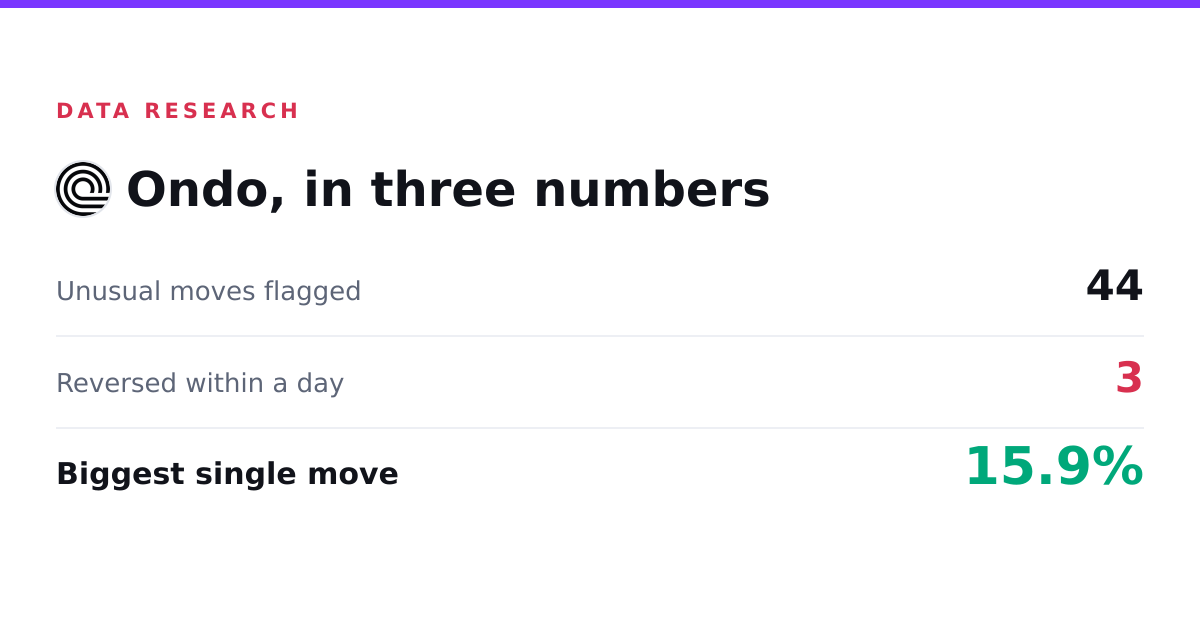
Between June 10 and September 7, 2026, Ondo tripped the unusual-move detector 44 times. Only three of those moves reversed a day later. That is a coin that says what it means and, for the most part, means what it says.
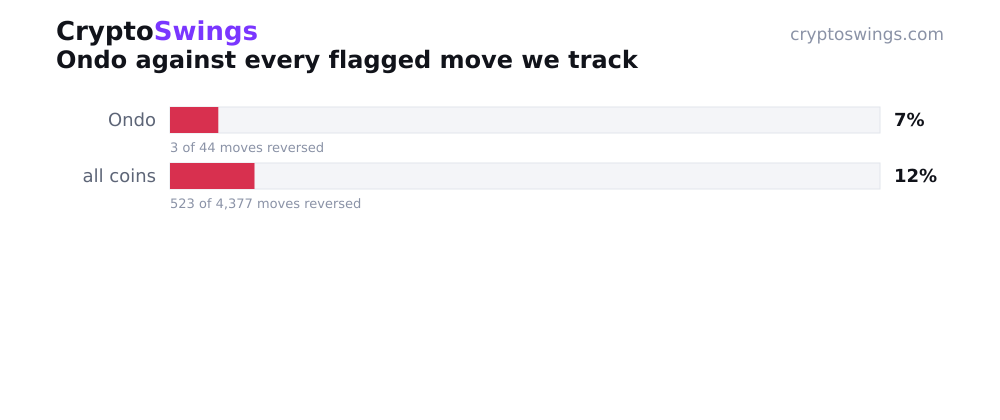
Three reversals out of 44 is a 6.8% reversal rate. Hold that number. It is the spine of this whole story, and it is quieter than you might expect from anything that shows up on a radar built to catch drama.
The Size Of The Splash
Ondo is not a fireworks coin. The typical flagged move landed around 5.1%, which is the kind of jolt that gets your attention without demanding your whole afternoon. Real, but measured. A step, not a leap.
Even at its loudest, Ondo kept its composure. The biggest single flagged move over the three months topped out at 15.9%. That is a respectable pop, but it is nowhere near the vertical, screaming candles that micro-caps like to throw before they collapse into themselves. Ondo's range runs from a nudge to a firm shove, and stops there.
Now the part I like most, because it is unusually balanced. Of the 44 flagged moves, 21 were rallies and 23 were sell-offs. That is about as even a split as the market ever hands you. Ondo does not have a favorite direction. It goes up loudly and it goes down loudly, in roughly equal measure, and it commits to both.
Put the pieces together and a personality emerges. Mid-sized moves, no strong bias up or down, and a stubborn tendency to stay put once it has moved. If most flagged coins are the friend who announces a dramatic life change and reverses it by Tuesday, Ondo is the one who actually follows through.
What "Normal" Looks Like, And Why Ondo Isn't It
Here is the comparison that gives Ondo's number its weight. Across every coin tracked, the reversal rate sits at 11.9%. That is the baseline: roughly one in a good handful of flagged moves ends up walking itself back within a day.
Ondo's 6.8% is a fair bit under that. It reverses less often than the broad field, which means when the detector flags Ondo, the move has better-than-average odds of still being there the next day. In a market where a lot of big prints are just noise wearing a costume, that is a genuinely notable habit.
It is worth saying plainly what this does and does not mean. A low reversal rate is not a promise that the next move sticks. It is a description of what already happened, forty-four times, over a fixed stretch of summer. But as descriptions go, it is a clean one: Ondo's moves have tended to be moves, not head-fakes.
There is a certain honesty to that. Ondo, the on-chain finance name, behaving like something with actual follow-through, the pun writes itself, and I will leave it there before it overstays.
How A Move Earns The Flag
Since the whole report rests on that word "unusual," it is worth being precise about what it means here, because none of these numbers came from a hunch.
Every figure comes from an automated system that watches price and flags moves large enough to stand out from a coin's normal behavior. When one of those flags fires, the move gets logged. Then the system checks back one day later and measures the flagged move against the real market price to see what actually became of it.
If the move held up, it counts as confirmed. If it unwound, it counts as a reversal. No interpretation, no story added after the fact. Just: something unusual happened, and here is where the price stood when the dust settled. That check-back a day later is the entire test, and it is the same test applied to Ondo, to the whole field, and to every reversal rate quoted here.
The strength of that method is that it is boring in the best way. It does not care what a move felt like in the moment. It only asks whether the price was still there afterward.
So, Did Ondo's Price Moves Reverse?
If you came here typing some version of "do Ondo's price moves reverse", the direct answer is that they mostly don't. Ondo reversed just 6.8% of its flagged moves, three out of 44, over the June-to-September stretch.
That is the headline in one line. When Ondo made an unusual move this summer, the overwhelming majority of the time it was still standing a day later. Three exceptions in three months. Against an all-coin reversal rate of 11.9%, Ondo landed well on the sticky side of the ledger.
It is a tidy answer, and I want to be careful not to oversell it, because a tidy answer is exactly the kind that tempts people to read more into it than the data holds.
Where The Numbers Stop Talking
Here is the honest fine print, and it matters.
This is a record, not a crystal ball. Everything above describes what Ondo already did between June 10 and September 7, 2026. It tells you how those 44 moves resolved. It does not tell you how the forty-fifth will go. A reversal rate is a rear-view mirror with very good resolution, and a rear-view mirror has never once shown anyone the road ahead.
The window is also fixed. Three months is enough to sketch a pattern, and Ondo's pattern here is a real and consistent one, but three months is still three months. A different stretch of market, a rougher tape, a calmer one, a sudden shift in how Ondo trades, could redraw the picture. The 6.8% is anchored to this specific window and no other.
And the comparison to the 11.9% baseline is only as clean as the buckets behind it. Where too few cases existed to say anything meaningful, they were left out rather than dressed up into a false trend. That is the right call, but it means the field Ondo is measured against is built from the moves that cleared that bar, not every twitch ever recorded.
So what would actually change the read? More time, mostly. If Ondo kept flagging moves and kept holding them at this rate over a longer stretch, the pattern would harden from "notable so far" into something closer to a trait. If reversals started piling up, the gap to the baseline would narrow and the story would shift. Either way, the tape gets the final word, one flagged move at a time.
The Line Worth Keeping
Strip away everything else and you are left with a simple, sturdy fact. Ondo threw 44 unusual moves and let all but three of them stand. Balanced between rallies and sell-offs, mid-sized in reach, topping out at 15.9% at its biggest, and reversing less than the broad field.
Not the flashiest coin on any given day. But over this window, one of the more reliable ones, in the narrow, specific, backward-looking sense that this kind of study can actually support. It is the sort of profile you notice not because it shouts, but because it keeps its word.