Pepe (PEPE) Price Moves: 51 Flagged, 1 Reversed
A Coin That Tends To Keep Its Word
Most micro-caps spend their time auditioning for drama. Pepe, by contrast, has been strangely well-behaved, and that is the more interesting thing to write about today.
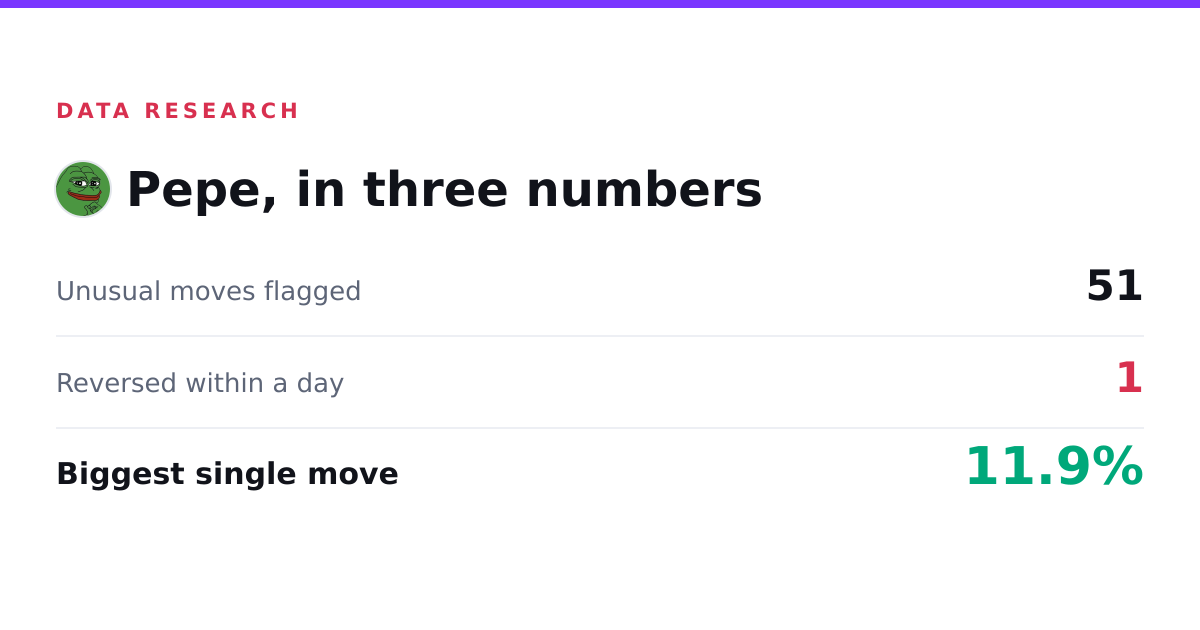
Here is the record in one line. Between June 5 and October 6, 2026, Pepe flagged 51 unusual moves, and of those, exactly one reversed within a day.
One. Out of fifty-one. That is the kind of consistency you do not expect from a coin whose entire identity is built on a cartoon frog. When Pepe moved over this stretch, it tended to mean it, and the follow-through usually stayed intact a day later.
The Shape Of Fifty-One Moves
Numbers like that need a texture, so here is the texture.
The typical flagged move came in around 4.8%. Not a scream, not a whisper. A respectable shove in one direction, the sort of thing that registers on a chart without demanding a magnifying glass. The biggest single move over the whole window reached 11.9%, which for a coin of this type is a loud day, but hardly the triple-digit fireworks that smaller names sometimes manufacture before lunch.
The split between up moves and down moves was almost even. Of the 51 flags, 27 were rallies and 24 were sell-offs. That is close to balanced, a coin that rose and fell in roughly equal measure rather than one that only ever lit up when it was being dumped or only ever when it was being chased.
So the portrait so far is a coin that moves at a sensible size, in both directions, and mostly keeps its word once it has made a move. Three traits that rarely travel together in this corner of the market.
When Steadiness Is The Headline
Here is where the record stops being merely tidy and starts being genuinely unusual.
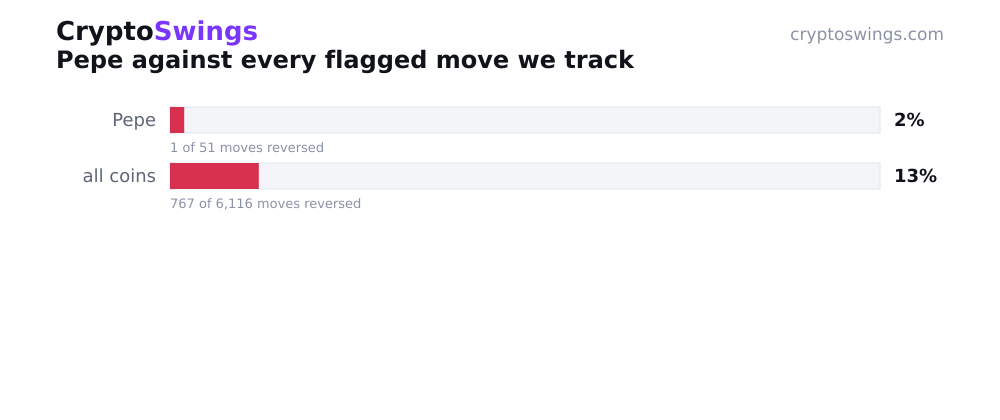
Across all the coins tracked, the typical reversal rate sits at 12.5%. That is the baseline. Flag a big move anywhere in the market, and a bit more than one in eight of those moves tends to turn around and give it back within a day. That is just the ambient noise of the thing.
Pepe's reversal rate was 2%.
Sit with the gap for a second. The broad average is 12.5%, and Pepe came in at 2%, which is roughly a sixth of what you would expect. Where the average coin leaks a meaningful share of its moves back almost as fast as it makes them, Pepe held on to nearly all of them. Over 51 flags, only a single move went soft and reversed. Everything else stuck, at least as measured a day out.
That does not make Pepe special in some cosmic sense. It makes it, over this particular window, unusually reluctant to fake people out. The moves it made, it kept.
How The Record Gets Kept
A word on where these figures come from, because "unusual move" is doing a lot of work and deserves a definition.
Every figure here comes from moves that were automatically flagged as unusual, meaning the price did something notable enough to stand apart from the coin's ordinary background fidget. Each of those flagged moves then gets checked against the real market price one day later. If the move held its direction, it counts as holding. If the price had changed its mind and walked the move back, it counts as a reversal.
That is the whole mechanism. Flag the outsized move, wait, measure it against the actual price one day later, and record which way it went. No interpretation, no mood reading, no guessing about why. Just a move, a day, and the price at the end of it. Fifty-one of those cycles ran their course for Pepe, and only one of them ended with the price having turned around.
So, Does Pepe (PEPE) Hold Its Moves Or Reverse Them?
If you came here asking whether Pepe tends to hold its moves or reverse them, the direct answer is that it holds them. It reversed just 2% of its flagged moves over this window, one out of 51.
That figure is the whole story in miniature. For a coin of this size, where the broad average reversal rate sits at 12.5%, a 2% rate is the exception rather than the rule. When Pepe made an outsized move during these four months, the overwhelming pattern was that the move was still standing a day later, whether it was one of the 27 rallies or one of the 24 sell-offs. A move of the typical size, around 4.8%, or even the biggest at 11.9%, tended to be a real move rather than a head fake.
Which is a plain way of saying: over this stretch, Pepe behaved like a coin that commits. It is a short sentence to describe four months of unusual restraint, but the numbers back it.
What This Record Can And Cannot Tell You
Now the honest part, because a clean number is the easiest thing in the world to over-read.
This is a record of what already happened. It is a backward-looking tally of 51 flagged moves between June 5 and October 6, 2026, and nothing in it reaches forward. A 2% reversal rate over those four months describes how Pepe behaved across those specific days. It does not promise the fifty-second move will hold, and it does not know what tomorrow's tape looks like. The window is fixed, and when the window is fixed, the story is finished the moment the last flag lands.
It is also a measurement taken at a single checkpoint. Each move is judged against the price one day later, which captures whether the move held at that mark and nothing about the path it took to get there. A move could have wandered, wobbled, and come back to roughly where it started, and the record would simply note that it held. The checkpoint is a snapshot, not a video.
And the tally only counts moves big enough to be flagged as unusual in the first place. All the ordinary daily drift that never crossed that threshold does not appear here at all. This is a study of Pepe's loud days, not its quiet ones, and the quiet ones are where most of any coin's life is actually spent.
What would change the picture? More time, mostly. A fresh run of flagged moves could pull that 2% rate up toward the 12.5% average, or it could hold it right where it is. A single stretch of reversals would move the number quickly, because 51 cases is a solid sample but not an enormous one. The record tells you what Pepe did. It does not tell you what Pepe is about to do, and anyone who says otherwise is reading tea leaves, not data.
For now, the ledger stands as it is. Fifty-one unusual moves, and exactly one of them turned around and changed its mind. In a market that treats a reversal as a default setting, a coin that holds its moves this consistently is worth noting, if only because it is so rare to see a frog stay this still.