Polkadot (DOT) Price Moves: 41 Flagged, 0 Reversed
On September 13, 2026, Polkadot printed its most recent unusual move, and it did the same thing it had done forty times before. It picked a direction and it kept it.
A Clean Sheet Nobody Expects On This Market
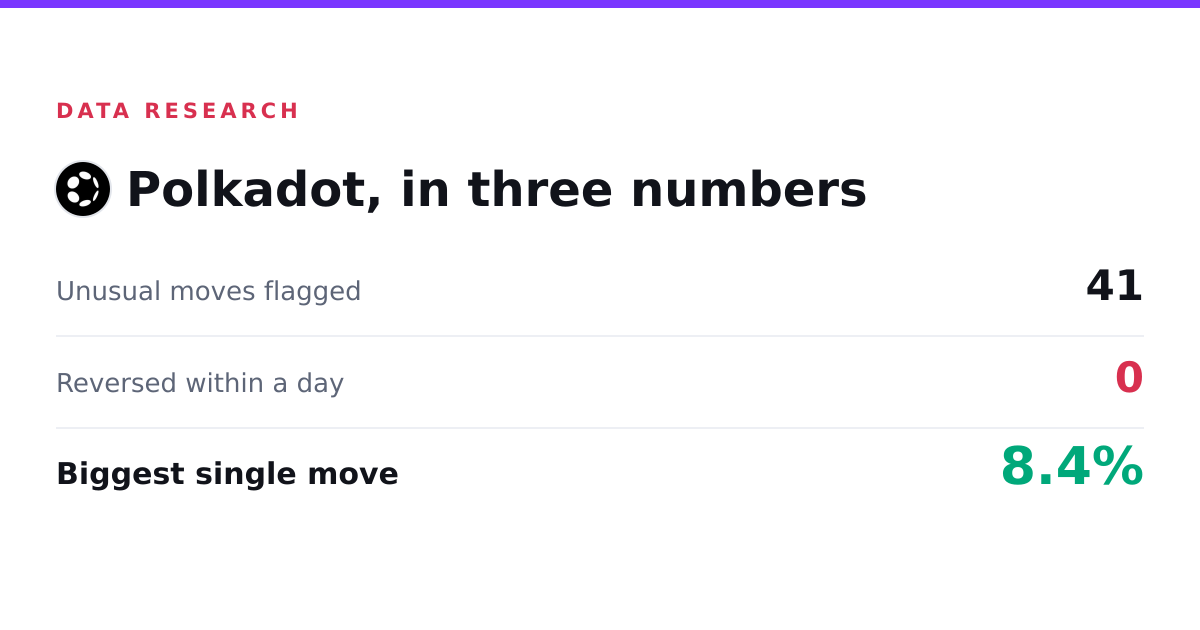
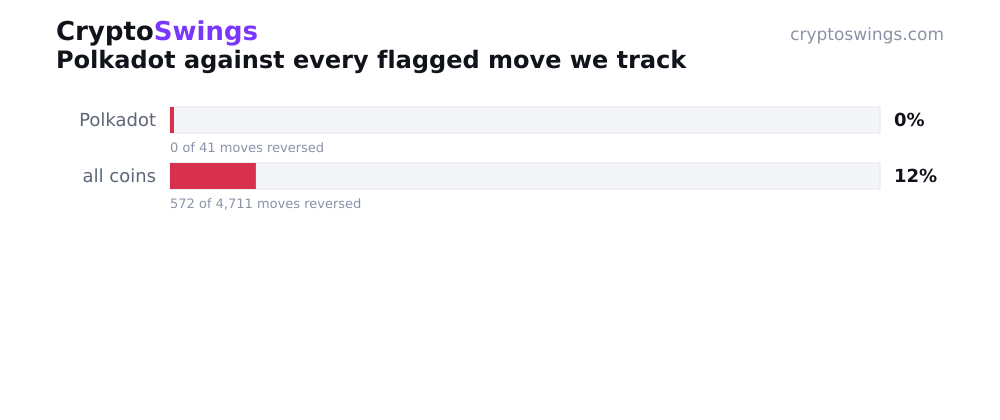
Here is Polkadot's record in one line: between June 10 and September 13, 2026, the coin was flagged for 41 unusual moves, and exactly none of them reversed a day later.
Zero. Not one. A shutout.
That is a strange thing to say about any crypto asset, because reversing is what the market does for a living. A move flares, a day passes, half of it is gone. Traders have built entire reflexes around that rhythm. Polkadot spent three months quietly refusing to play.
Whatever DOT did in that window, it meant it. Up stayed up. Down stayed down. And when a coin holds its footing 41 times without slipping once, the record starts to feel less like luck and more like temperament.
The Shape Of A Move That Doesn't Flinch
So what did these moves actually look like? Nothing theatrical, and that is the whole point.
The typical flagged move ran about 4.5%. The biggest one across the entire stretch topped out at 8.4%. That is the ceiling. Three months of unusual activity and the loudest single print did not clear nine percent.
For a market where micro-caps casually double before lunch, those numbers read almost polite. Polkadot was not out here doing acrobatics. It was moving in measured, deliberate steps, and every step landed where it aimed.
The direction split was nearly even. Of the 41 moves, 23 were rallies and 18 were sell-offs. So this is not a story of a coin grinding relentlessly one way while the tape catches up. DOT went up, DOT went down, roughly in balance. What stayed constant was not the direction. It was the follow-through.
That is the detail that makes the record interesting. A coin that only ever ripped higher and held would just look like a strong trend. Polkadot held its sell-offs too. When it dropped, the drop stuck. The discipline cut both ways, which is rarer and harder to wave off as a lucky streak.
Why Zero Is A Number Worth Stopping On
Now put that record next to the neighborhood.
Across every coin tracked, the reversal rate sits at 12.1%. Roughly one in eight unusual moves gives back its direction within a day, market-wide. That is the baseline. That is normal. That is the tax the tape collects on moves that overreach.
Polkadot paid none of it.
Twelve percent is not a huge number until you try to hit zero against it over 41 separate chances. Think of it as a coin flip weighted heavily toward heads, tossed four dozen times, landing heads every time. At some point you stop calling it variance and start calling it a trait.
A move of 4.5% is not so large that it strains to hold. A move of 8.4% is bigger, sure, but still nowhere near the fireworks that usually snap back the hardest. Polkadot's moves tended to land inside a range that the market could absorb without a violent correction the next day. Modest size, honest direction. That combination is exactly the recipe for a clean sheet, and Polkadot cooked it 41 times running.
The takeaway is not that DOT is safe or strong or any adjective a chart cannot prove. The takeaway is narrower and sturdier: over this window, when Polkadot moved unusually, that move described where the price actually went, not a head-fake it would take back. It said what it meant.
How A Move Earns The Word Unusual
A quick word on the machinery, because a shutout only means something if you know what it counts.
Every figure here comes from moves that were automatically flagged as unusual, price action that stood out from the coin's ordinary background noise, not a routine wiggle. That flag is the entry ticket. It is what puts a move into this dataset in the first place.
Then comes the test. Each flagged move gets checked against the real market price one day later. Did the move hold its direction, or did the price turn around and hand it back? Hold, and it counts as confirmed. Reverse, and it counts as reversed.
That is the entire mechanism. Flag the unusual move, wait, measure against reality. No opinions, no forecasts, no interpretation of what should have happened. Just what the price did, then what the price did next. For Polkadot, the answer to the second question was, every single time, the same as the first.
Did Polkadot Reverse Its Moves? The Direct Answer
If you came here asking whether Polkadot reversed its unusual moves, here is the answer with no wrapping: no. Across 41 flagged moves between June 10 and September 13, 2026, Polkadot reversed zero of them, for a reversal rate of 0%.
Set that against the 12.1% reversal rate across all tracked coins and the gap tells the whole story. The wider market gives back better than one flagged move in eight. Polkadot gave back none. That is not a small edge over the baseline. That is the baseline stepping aside entirely.
Direction held on the rallies. Direction held on the sell-offs. Forty-one for forty-one. If you were looking for a coin whose unusual moves came with an asterisk, a quiet expectation that they might unwind, this window does not have one to offer you.
What A Clean Record Can't Promise
Now the honest part, because a perfect number deserves a skeptic in the room.
This is a record of what happened. It is not a forecast, and it cannot become one. Forty-one confirmed moves over three months tell you exactly how DOT behaved between June 10 and September 13, 2026, and nothing about what the forty-second move will do. A clean streak carries no obligation to continue. Streaks end. That is a feature of the market, not a bug in Polkadot.
The window is fixed, too. Move the start and end dates and you would be looking at a different set of moves, possibly a different pattern entirely. What sits here is one slice of time, bounded and specific. It does not stretch backward or forward on its own.
And the measurement is deliberately narrow. Every move was judged against the price one day later, no more. What happened two days out, a week out, a month out is simply not in frame. A move that held for a day and drifted afterward would still count as confirmed here, because confirmed is a statement about the day after, not about forever.
There is also a plainer limit worth naming. The dataset only includes moves loud enough to get flagged as unusual. All the ordinary trading in between, the small drifts, the quiet grinds, never entered the count. This is a study of the standout moments, not the full day-to-day life of the coin.
What would change the picture? A single reversal on the next flagged move would dent the perfect rate. A longer measurement horizon might catch moves fading after the first day. A different window might surface a streak that never was. None of that is here yet.
For now, the record stands, unambiguous and a little uncanny. Polkadot moved unusually 41 times, and 41 times the market agreed with it the next day. Most coins on this market cannot go a dozen without blinking. DOT went the full stretch without one. In a market that reverses for a living, that is a coin that simply refused to take anything back.