XRP (XRP) Price Moves: 51 Flagged, 3 Reversed
The Move That Held Its Ground
A big coin lurches. The chart jumps, the tape gets loud, and the instinct honed by a thousand micro-caps kicks in: brace for the giveback. Wait for the candle to fold in on itself. Watch the whole thing evaporate by morning.
With XRP, that morning mostly never came.
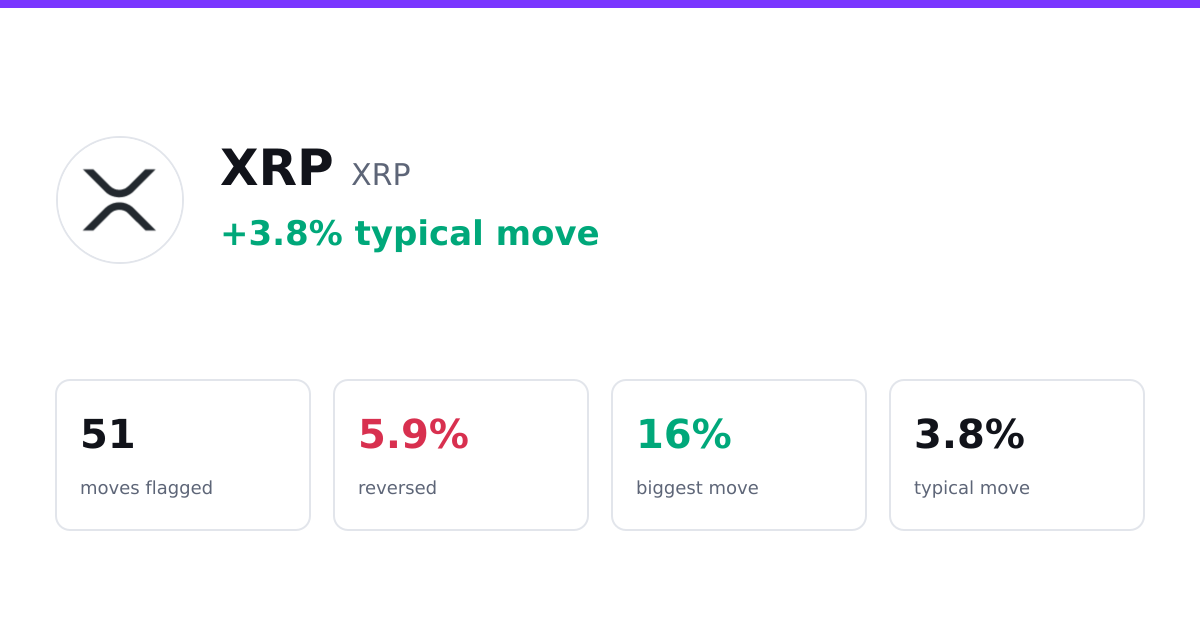
Between June 5 and September 28, 2026, XRP produced 51 unusual price moves, the kind big enough to get automatically flagged as out of the ordinary. Of those 51, only three reversed direction when measured against the real market price one day later. That is a coin that, whatever else you want to say about it, tends to keep going the way it started.
The Shape Of A Lurch
Strip the 51 events down and a pattern emerges that is almost boring in its consistency, which for a crypto asset is a compliment.
The typical flagged move ran about 3.8%. Not a firework. Not the kind of number that turns heads across a trading desk. For XRP, a coin whose market cap does not need theatrics to matter - 3.8% is a meaningful lean, and it happened again and again over the four months.
The biggest single move on record reached 16%. That was the outlier, the one moment XRP dressed up in the wardrobe of something far smaller and more volatile. Even so, 16% is a stretch a genuine micro-cap can post before lunch. For a coin of XRP's heft, it was the loudest thing on the tape all summer.
Now the split, which is where it gets interesting. Of the 51 flagged moves, 21 were rallies and 30 were sell-offs. The downside outnumbered the upside by a fair margin. XRP spent this stretch flinching more often than it leapt, but here is the thing worth sitting with: whether it flinched or leapt, it usually stuck the landing. Direction, once chosen, mostly held.
Why Three Out Of Fifty-One Is The Real Story
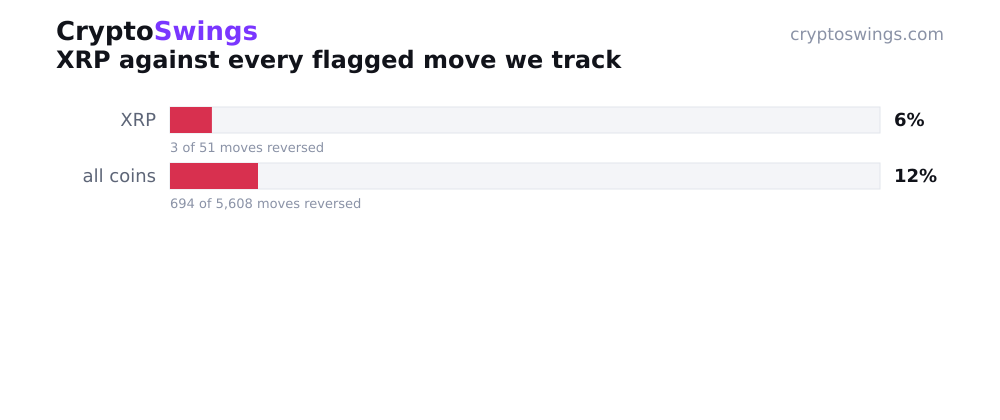
A reversal rate is just the share of moves that turned around and went the other way within a day. For XRP, three reversals out of 51 works out to 5.9%.
Set that against the backdrop. Across every coin tracked, the reversal rate sits at 12.4%. XRP came in at less than half of that.
That gap is the whole report in one line. The average coin, when it makes a big move, has roughly a one-in-eight chance of that move being a head fake, a spike that fades or a drop that bounces back within a day. XRP cut that risk down considerably. When it moved, it committed.
There is a rough logic to it. Very small coins get pushed around by very small amounts of money, which makes their big candles fragile, easy to inflate, easy to deflate. A coin the size of XRP takes real volume to shift, and volume that big does not usually reverse itself overnight on a whim. The follow-through is baked into the size. Still, seeing it land this cleanly across 51 separate events is the kind of result that turns a hunch into a number.
Whatever XRP does when it lurches, it mostly means it.
How A Move Earns The Label
Worth being precise about what is being counted here, because the whole thing collapses if the definition is fuzzy.
Every figure comes from moves that were automatically flagged as unusual, price behaviour that stood out from XRP's normal chatter, not the ordinary ticks that fill a quiet afternoon. Once a move got flagged, the outcome was settled a simple way: compare it to the real market price one day later. Did the move hold its direction, or did it flip?
No interpretation, no mood reading, no judgment call. Just the flag, then the price a day on. A rally that was still a rally the next day held. A sell-off that clawed back into the green reversed. That is the entire scoring system, and it is why the 5.9% figure means something concrete rather than something vibed into existence.
Fifty-one events is also a healthy sample. This is not two lucky candles and a headline. It is nearly four months of XRP being watched every time it stepped out of line, and a tally of how often the step held.
Does XRP Reverse Its Price Moves?
Here is the question a lot of people actually type: does XRP reverse its price moves, or does a big XRP candle tend to stick?
The direct answer: XRP reversed just 5.9% of its 51 flagged moves over this period, only three of them turned around within a day. The overwhelming majority held their direction. So if you are asking whether XRP's big swings are typically head fakes, the record over this window says no, decisively. A flagged move here was far more likely to be the start of something than a trap that unwound by the next day.
That is a low reversal rate in absolute terms and a strikingly low one relative to the broader field, where the reversal rate reads 12.4% across all tracked coins. The data behind these counts comes from CryptoSwings, which logs these unusual moves and checks each one against the real price a day later.
For a coin that gets talked about as much as XRP does, the actual behaviour was almost undramatic. It moved, and then it kept moving the same way. Over and over.
What The Number Cannot Promise You
Now the fine print, because a clean number deserves an honest frame.
This is a record of what happened, not a map of what happens next. Fifty-one moves over one fixed stretch, June 5 to September 28 - tell you how XRP behaved in that window and nothing about tomorrow's candle. A 5.9% reversal rate over four months is a fact about the past. It is not a promise, a signal, or a reason to do anything in particular. The next flagged move is not obligated to honor the pattern just because 48 of its predecessors did.
The window is also closed. It starts and ends where it starts and ends, and a different four months, a quieter market, a wilder one, a different phase of the cycle entirely, could produce a completely different reversal rate. Markets change their temperament. A record built in one season does not carry a warranty into the next.
And there is a structural limit worth naming: this only measures moves that got flagged. The ordinary drift, the slow bleeds and quiet grinds that never crossed the unusual threshold, are not in here. This is a study of XRP's dramatic moments, not its full biography. If XRP spent whole weeks doing very little, those weeks left no fingerprint on this tally.
What would change the picture? More moves, a longer window, a sharp shift in market conditions. Any of those could nudge that 5.9% up or down. But taken on its own terms, a fixed stretch, 51 flagged events, a simple next-day check, the record is unusually tidy. XRP got flagged 51 times. Forty-eight of those flags held their direction into the following day.
For a market that specializes in taking things back, a coin that mostly keeps its word is worth a second look.