Bittensor (TAO) Price Moves: 44 Flagged, 1 Reversed
Forty-Four Swings, One Change Of Heart
Somewhere in the middle of a summer that ran from early June into late September, Bittensor kept doing the same slightly unusual thing. It would jump. Or it would drop. And then, the next day, it would mostly stay put.
*Previously: Bittensor Adds 11.2% in a Day That Broke Its Own Mold*
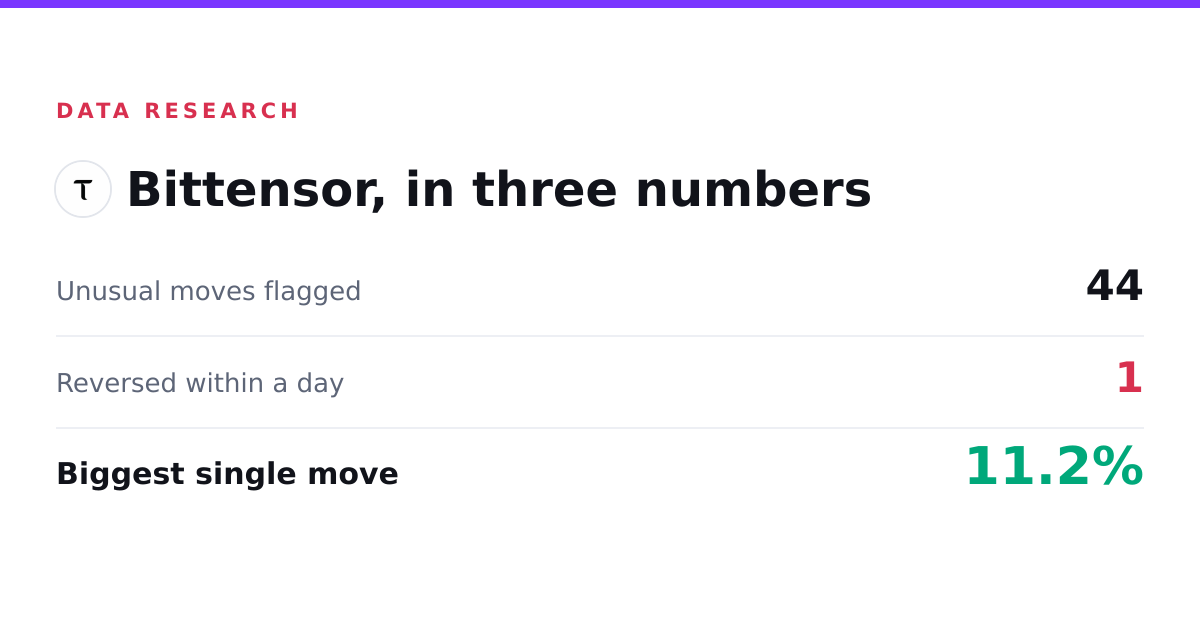
That is the quiet headline buried in the data: across that stretch, Bittensor flagged 44 unusual price moves, and exactly one of them reversed a day later.
Forty-four moves worth flagging. One that pulled a U-turn. Everything else held its direction into the next day like it had somewhere to be.
Medium Swings, Split Right Down The Middle
Here is the texture of those moves, because size matters as much as count.
The typical Bittensor move that got flagged came in around 5%. Not a firework, not a rounding error, a real shove that a chart-watcher would notice without leaning in. The biggest one in the whole window reached 11.2%. That is the ceiling here, and it is a modest ceiling. No triple-digit candles, no vertical spikes that snap the axis. Bittensor was moving with purpose, not theatrics.
And the direction split is almost suspiciously tidy. Of the 44 flagged moves, 22 were rallies and 22 were sell-offs. A perfect coin-cut down the center, the token spent the period pushing up and pushing down in equal measure, with neither side running away with it.
So the picture is a coin that moves a fair bit, moves in both directions evenly, and rarely takes any of it back.
What "Rarely Reverses" Actually Looks Like
Let's put the reversal number where it belongs.
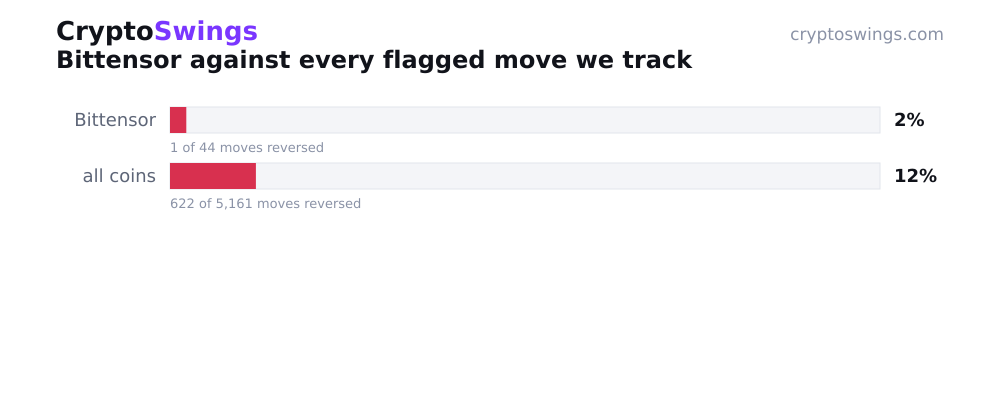
One flip out of 44 works out to a reversal rate of 2.3%. Across every coin in this dataset, the reversal rate sits at 12.1%. So the average tracked coin takes back its move the next day several times more often than Bittensor did.
That gap is the story. Most coins throw out a move and then hedge on it, the next day undoes some or all of what the last day built. Bittensor mostly didn't. When it went, it went, and the following day let the move stand. Forty-four unusual moves, and forty-three of them simply meant it.
It is the kind of consistency that shows up more in workhorses than in lottery tickets, which is roughly the vibe of the whole window, a coin that flags a lot and reverses almost nothing is a rare kind of steady on a board that usually loves a plot twist.
How A Move Earns The Flag
Worth pausing on what these numbers actually count, because "unusual move" needs a definition or it means nothing.
Every figure here comes from moves that were automatically flagged as unusual, the tape doing something outside its normal range, big enough to stand out from the day-to-day noise. That is the trigger. Nothing gets counted just for existing.
Then comes the follow-up. The outcome of each flagged move is measured against the real market price one day later. Did the move hold its direction, or did the next day walk it back? A rally that faded, a sell-off that bounced, those are the reversals. A move that stuck is a move that stuck.
So the 2.3% figure is not a mood or a guess. It is 43 moves that held and one that didn't, checked against actual prices a day after each event. Plain arithmetic on plain observations.
That matters because it keeps the whole exercise honest. We are not grading how dramatic the moves felt or how they looked mid-candle. We are asking one narrow question, did tomorrow agree with today, and counting the yeses and nos.
Does Bittensor (TAO) Reverse Its Price Moves?
If you typed something like "does Bittensor reverse its price moves," here is the direct answer: rarely. Over the window studied, Bittensor reversed just 1 of its 44 flagged moves, a reversal rate of 2.3%, against a 12.1% rate across all tracked coins.
In plain terms, when TAO made an unusual move during this stretch, the next day tended to confirm it far more often than not. The rally that ran usually didn't hand it back the following day. The sell-off that hit usually didn't bounce out of it. That is what the record shows, a coin whose moves, once made, mostly stayed made.
That does not tell you which direction the next move goes. Remember the split - 22 up, 22 down, evenly matched. What the data describes is durability, not direction. Bittensor's moves stuck. It just didn't play favorites about which way they stuck.
Where This Record Stops Being Useful
Now the part that keeps everyone honest, because a clean number invites overreach.
This is a record of what already happened. It is 44 events between early June and late September, each one checked against the price a day later, and nothing more. It does not know what Bittensor will do tomorrow, next week, or the moment this window closes. A low reversal rate over a fixed stretch is a fact about that stretch, not a promise the token will keep behaving the same way.
The window itself is a hard boundary. Start it a month earlier or extend it a month later and the count could shift, the split could tilt, the reversal rate could climb or fall. Every figure here lives inside those specific dates. Change the dates and you are looking at a different picture, possibly a very different one.
There is also the matter of what gets excluded. This kind of study only holds up when there are enough cases to count. Buckets too thin to say anything meaningful get left out rather than dressed up as signal, which is the right call, one or two data points is an anecdote, not a pattern. It keeps the numbers clean, but it also means the story is only ever as complete as the events that cleared the bar.
And the moves themselves stayed modest. The biggest was 11.2%, the typical one around 5%. This is not a coin that produced the sort of vertical spikes that turn into cautionary tales. So the low reversal rate is describing a token that moved in measured steps and largely held them, not one that survived wild swings. A wilder window might read completely differently.
What would change the picture? A longer sample. A volatile stretch. A run of much bigger moves. Any of those could push the reversal rate off its current 2.3%, and the honest position is that we would not know until it happened.
The Shape It Left Behind
Strip it all down and Bittensor's summer reads like a coin that did what it said. Forty-four flagged moves. A tidy 22-and-22 split between rallies and sell-offs. Moves that typically ran about 5% and topped out at 11.2%. And one lonely reversal in the whole set, for a rate of 2.3% against a 12.1% norm.
That is not a forecast and it is not advice. It is a photograph of a specific window, and in that window, TAO mostly meant what it did the moment it did it. On a board where coins routinely take back their moves the next morning, one that almost never does is worth noting, and worth remembering that the note has an expiration date the moment the window moves.