Ethena (ENA) Price Moves: 63 Flagged, 8 Reversed
Eight Takebacks Out of Sixty-Three
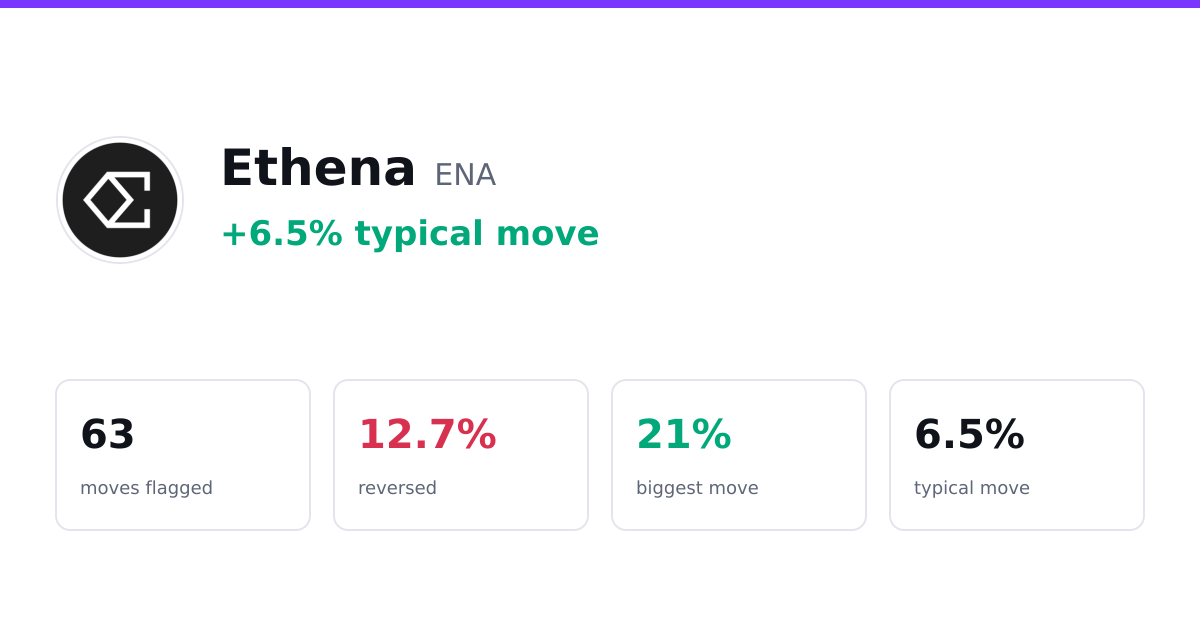
Here is the weight of it in one number. Ethena tripped the unusual-move alarm 63 times between July 21 and November 22, 2026, and only eight of those moves ever reversed within a day.
Sit with that for a second. Sixty-three times the price did something sharp enough to register as abnormal. And in the overwhelming majority of those, whatever direction it went, it stayed gone. A move that holds is a move that meant it. Ethena, across four months, mostly meant it.
That is not what you expect from a flagged move. The whole premise of an unusual move is that it looks like it might be an overreaction, the kind of jolt that snaps back once the dust clears. For most coins, a decent slice of those jolts do snap back. For Ethena, almost none did.
A Coin That Moves in Measured Steps
Look at the typical size and the picture gets calmer, not wilder. The average unusual move here ran about 6.5 percent. That is not a cliff. That is not a coin going vertical at noon and hollowing out by dinner. It is a steady, mid-single-digit shove, repeated five dozen times over four months.
Even the extreme was restrained by micro-cap standards. The biggest move in the whole record was 21 percent. That is a real day, the kind that gets your attention, but it is nowhere near the three- and four-figure fireworks you see out at the far edge of the market. Ethena's wildest day would be a rounding error for some of the coins that light up the radar.
And then there is the balance. Of the 63 flagged moves, 31 were rallies and 32 were sell-offs. You could not design a more even split if you tried. There is no directional bias baked into this record, no sense that the alarm only goes off when the price is climbing or only when it is falling. Up and down got called almost exactly the same number of times.
Put the three facts together, modest size, a near-perfect split between green and red, and a reversal count you can hold on two hands, and you get a coin whose unusual moves are less like ambushes and more like deliberate steps. It goes where it goes, and it tends to stay.
Against the Field, It Lands Right in the Middle
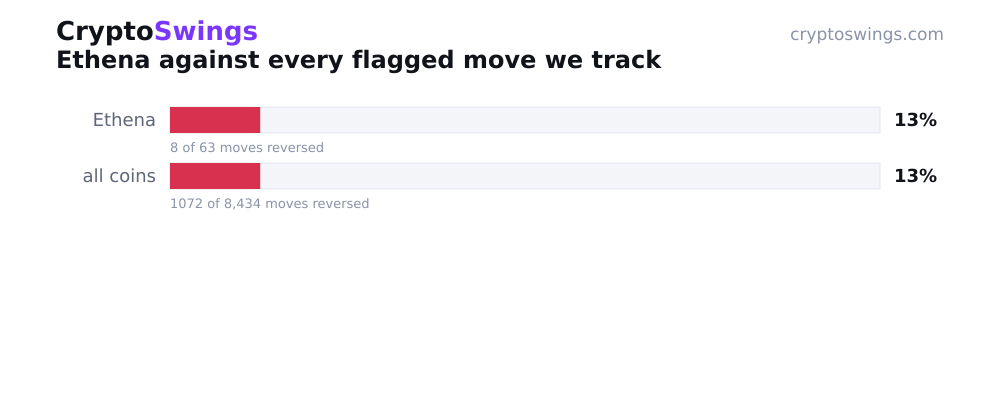
Here is the part that keeps the story honest. Across every coin tracked, the reversal rate sits at 12.7 percent. Ethena's reversal rate is 12.7 percent.
Not close to. Not approximately. The same figure, to the decimal.
So the eight-out-of-63 record that felt so stubborn in isolation turns out to be exactly ordinary once you set it against the broader market. Ethena is not an outlier for refusing to take its moves back. It is the baseline. If you wanted a living definition of how often a flagged move reverses on average, you could point at this coin and call it a day.
That is its own kind of interesting. Plenty of coins swing far above or below that 12.7 percent line, some that snap back constantly, some that almost never do. Ethena threads the needle and sits right on the number. Sixty-three moves, and the law of averages came out to meet it at the door.
The low reversal rate, then, is not a quirk of Ethena. It is a reminder that flagged moves, as a rule, mostly stick. The alarm catches real motion more often than it catches noise. Ethena just happens to demonstrate that rule with textbook precision.
What Actually Counts as a Move Here
A quick word on the machinery, because the numbers only mean something if you know what fed them.
Every figure in this record comes from automatically flagged unusual moves, price action sharp enough to stand out from Ethena's normal background noise. Nobody is eyeballing charts and deciding what looks dramatic. The flag is mechanical.
Then comes the test. For each flagged move, the outcome gets measured against the real market price one day later. If the move held its ground, it stands. If the price unwound it, that counts as a reversal. That is the entire scoring method: did the move survive a day, or didn't it. No interpretation, no judgment calls, just the price then versus the price now.
It is a clean way to separate the moves that meant it from the moves that were just a flinch. And for Ethena, the overwhelming verdict was: it meant it.
So, How Often Do Ethena's Price Moves Reverse?
If you came here asking how often Ethena's flagged moves reverse, here is the direct answer: 8 of its 63 unusual moves reversed within a day, a reversal rate of 12.7 percent.
That means the odds, on this record, ran heavily toward the move sticking. Roughly seven times in eight, when Ethena posted something sharp enough to get flagged, that move was still standing a day later. The reversal was the exception, not the rule, and it lined up precisely with what the wider market does on average.
Worth repeating the texture behind that headline figure: the moves were modest, averaging 6.5 percent, and split almost down the middle between rallies and sell-offs. This is not a coin that spikes and collapses. It is one that drifts in measured steps and tends to keep whatever ground it takes.
You can find coins out there whose records read like a haunted house, every sharp move followed by an immediate retreat. This is not one of them. CryptoSwings tracks a whole spectrum of these temperaments, and Ethena's is the dependable, unremarkable kind, which, in a market this noisy, is almost a personality trait.
What This Record Can't Tell You
Now the honest part, because a clean number is easy to over-trust.
This is a record of what already happened. It is not a forecast. The 63 moves it covers are the 63 that occurred between July 21 and November 22, 2026 - a fixed window, bolted shut at both ends. Nothing in here promises that the next flagged move behaves like the last 63. A record is a mirror, not a map.
The window matters more than it looks. Stretch it earlier or later and the counts shift, the split shifts, the reversal rate shifts. Four months is four months. It is enough to see a pattern and not enough to swear by it forever.
*Previously: Four Climbed 42% And Still Ended The Day Underwater*
There is also the matter of what gets excluded. A study like this leans on frequencies, and frequencies only mean something when you have enough cases to count. Thin slices, any bucket with too few examples to say anything real, get left out rather than dressed up as a trend. Better to report the solid ground than to pretend the thin ice holds weight.
So take the 12.7 percent for exactly what it is: a faithful tally of how Ethena behaved across one stretch of 2026, measured one day at a time, with nothing editorial smuggled in. Eight reversals out of 63. A coin that mostly committed to its moves, that mirrored the market average to the decimal, and that never once went truly vertical.
The alarm rang 63 times. Ethena answered it almost every time with the same quiet reply: this one is staying.