Gram Climbs Quietly, Then Gives Back Twice the Gain
The Rally That Tiptoed In
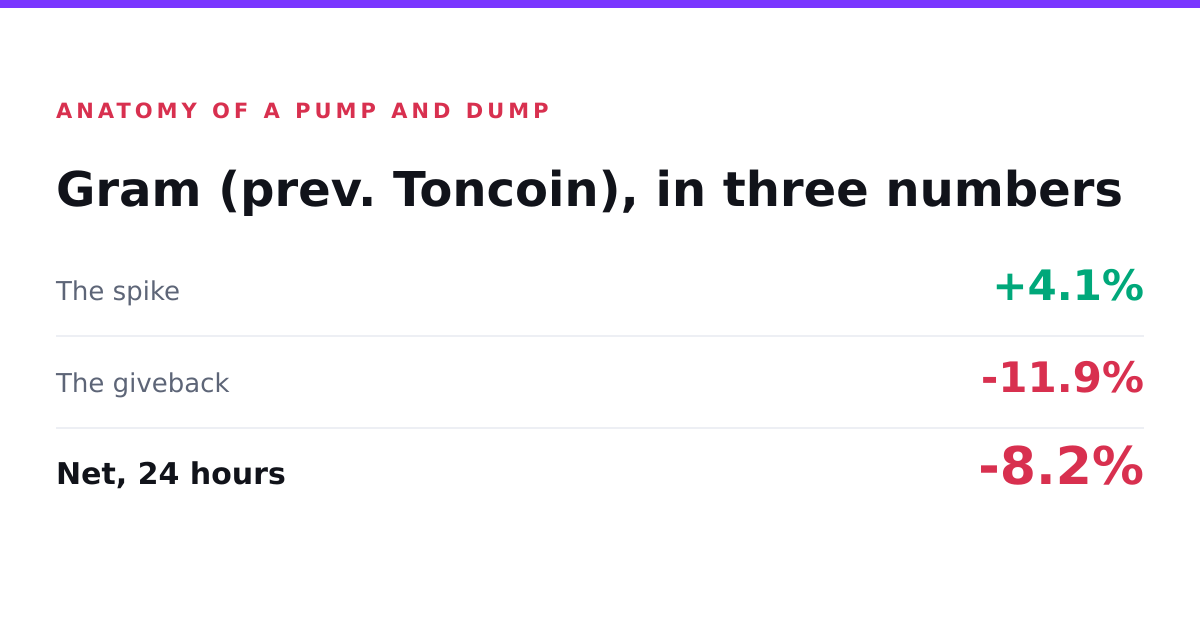
Picture a token doing everything right and nobody noticing. That was Gram, the asset still wearing its "previously Toncoin" label, on June 24, 2026. It spent the day grinding higher with the patience of something that did not want to wake the room. No fireworks, no vertical candle, just a steady 4.1 percent crawl that you could have missed if you blinked at the wrong hour.
Then the room woke up anyway. By the close, all of that quiet progress was gone, and Gram sat down 8.2 percent on the day. The climb was a whisper. The drop did all the talking.
If you came in looking for the catalyst, here is the unsatisfying part: there barely was one. Volume ran at 1.3 times a typical session. That is not a stampede. That is a slightly crowded elevator, and it was enough to take the whole thing down.
Walking the Replay
The shape here is the polite version of an ugly pattern. Most pump and dumps announce themselves with a screaming spike. Gram did not. It accumulated its gain across the day, the kind of slow build that looks like genuine demand right up until it stops looking like anything at all.
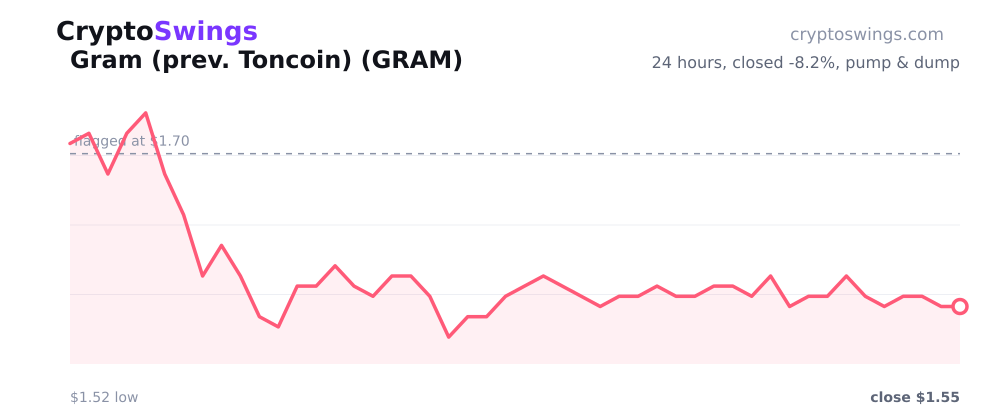
The peak landed near that 4.1 percent mark. And then the floor went soft. Whatever buying had been holding the token up simply stepped aside, and Gram fell straight through its starting point, settling at minus 8.2 percent. That is the detail worth sitting with: the giveback was twice the size of the run. Traders who climbed aboard near the top did not get a flat round trip. They got the basement.
The whole thing carried the texture of a mid-cap that drifted up on thin conviction and could not defend the level when sellers decided the party was over.
Not a Stranger to the Spotlight
This is familiar territory for Gram. The token has logged eight unusual moves on the radar now, which makes June 24 less of a debut and more of a rerun with a fresh cast.
What is interesting is the scale. Its biggest run on record sits at 5.5 percent, and its worst dump at minus 6.8 percent. The 8.2 percent slide on this particular day cleared that previous low. So while the move looked modest by the standards of micro-cap chaos, for Gram specifically, this was a new personal worst on the downside. The coin set a record, just not the kind anyone frames.
The recurring theme across its history is the fakeout: gains that look like they might mean something and then quietly do not. June 24 fit the file perfectly.
What the Read Got Wrong
Here is the bit that stings. Going into the move, community sentiment data leaned bullish, only narrowly, but it leaned the right way for the wrong outcome. The read was wrong. And almost nobody saw the reversal coming, which is exactly what makes a slow climb so persuasive. It does not look like a trap. It looks like progress.
That is the lesson buried in a fairly ordinary day. The dramatic pumps, the 100-percent vertical spikes, those at least come with a warning label stapled to the candle. A 4.1 percent drift that takes all day to build is harder to read, and when it unwinds, it tends to unwind further than the gain that lured people in.
Gram's gain was quiet. Its giveback was not subtle at all. By the close it was down 8.2 percent, the volume had mostly gone home, and the token went back to being the mid-cap that occasionally raises its hand and then politely lowers expectations.
Eight flagged moves in, the pattern is no longer a surprise. The timing, as ever, is the only part nobody can call.