Internet Computer (ICP) Price Moves: 52 Flagged, 3 Reversed
The market has a reputation for giving with one hand and taking with the other, usually before you have finished congratulating yourself. Some coins live up to it. Internet Computer, over a long stretch this summer and fall, mostly did not.
Four Months, Fifty-Two Moves, Three Turnarounds
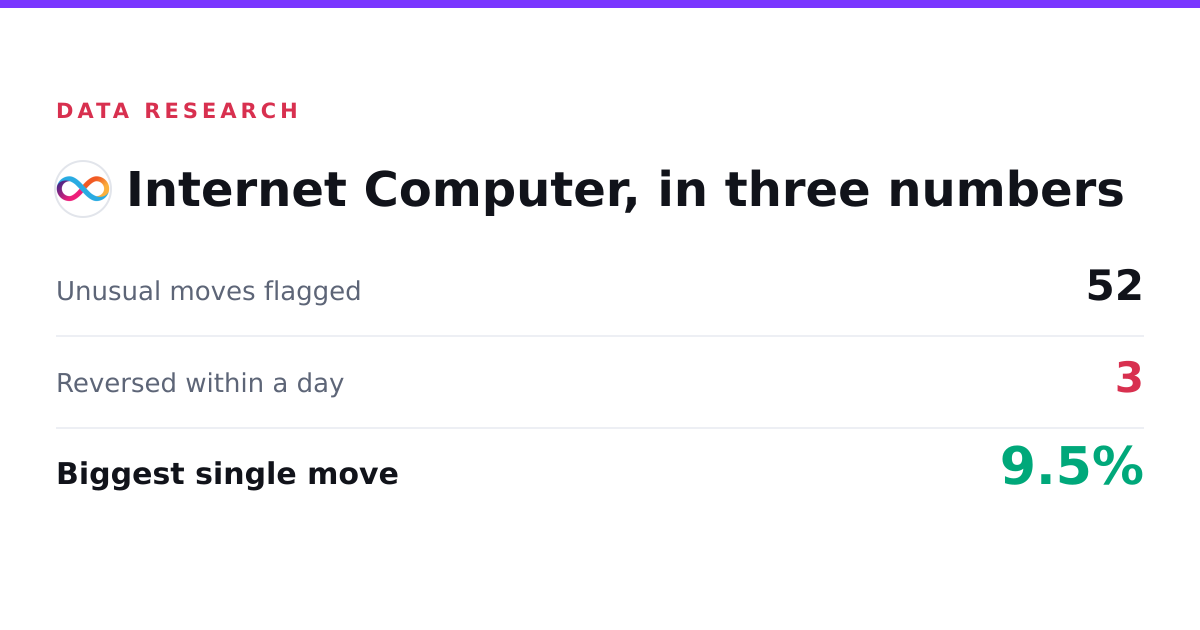
Here is the whole story in one line. Between June 10 and October 1, 2026, Internet Computer logged 52 unusual price moves, and only three of them reversed within a day. That is the record. Everything else is detail filling in around it.
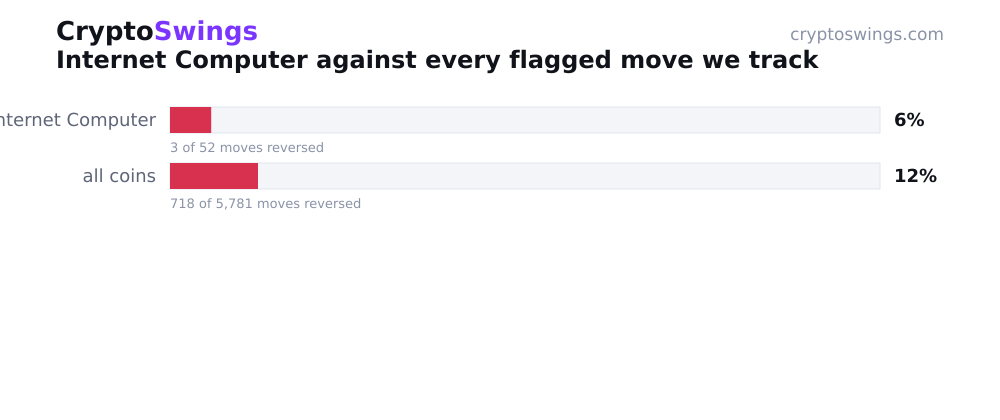
A reversal, for the purposes of this record, is simple: the price makes a notable move, then changes its mind and heads back the other way shortly after. ICP did that three times out of 52 chances. The other 49 times, whatever direction it set off in, it stayed roughly committed to it a day later. For a market that specializes in buyer's remorse, that is a fairly steady hand on the wheel.
The Size And Shape Of The Moves
So what did these moves actually look like? Nothing cinematic, which is part of the point.
The typical flagged move came in around 4.7 percent. The biggest one across the entire four-month stretch reached 9.5 percent. That is the ceiling here, no triple-digit moonshots, no decimal points you have to squint at twice. ICP's version of unusual is a coin that steps out of its usual range without pretending to be a different asset class entirely.
The direction split leaned green. Of the 52 flagged moves, 30 were rallies and 22 were sell-offs. So the coin spent a little more of its noteworthy energy climbing than falling, though neither side ran away with it. This is a coin that moves in both directions and, once it picks one, tends to see it through.
Put the size and the follow-through together and you get the character of the thing. ICP's moves are moderate in scale and durable in outcome. It does not spike hard, and it does not often snap back. What you see at the top of the move is, more often than not, close to what you still see a day later.
Steadier Than Its Neighbors
Here is where the number earns a second glance. Across every coin in this tracking, the reversal rate runs at 12.4 percent. ICP's rate is 5.8 percent.
That is less than half the typical frequency. Where the average coin flips direction on roughly one in eight notable moves, Internet Computer did it on far fewer. A flagged move on ICP, in other words, was considerably more likely to hold than a flagged move picked at random from the broader field.
It is worth sitting with what that means in plain terms. A lot of coins generate a loud move and then quietly give it back, leaving anyone who reacted to the headline number holding something smaller than advertised. ICP, over this window, did that less often than most. The moves it made tended to be the moves it kept.
That does not make it exciting. Moderate size, high follow-through, and a reversal rate under six percent is not the profile of a coin that makes anyone's heart rate spike. But it is a clean, legible pattern, and clean patterns are rarer than they sound.
How A Move Earns The Flag
A word on the machinery, because the numbers only mean something if you know what they are counting.
Every figure here comes from automatically flagged unusual moves, price action that breaks out of the coin's normal behavior enough to get noticed. Each flagged move then gets a verdict, measured against the real market price one day later. Did the move hold its ground, or did it reverse? That after-the-fact check is the entire basis of the reversal rate.
Nothing here is hand-picked or cherry-selected. The system flags the move, waits, and then checks what the price actually did against itself one day on. The 5.8 percent reversal rate for ICP is just the share of those 52 flagged moves that turned around. No modeling, no projection, just a count of what happened and how often.
The typical move of 4.7 percent and the biggest of 9.5 percent come from the same pool, the observed sizes of the moves that got flagged, nothing added, nothing rounded up for effect.
Does Internet Computer Reverse Its Price Moves?
If you came here asking whether Internet Computer tends to reverse its price moves, the answer is no, not often. Across 52 flagged moves over nearly four months, it reversed three of them, a reversal rate of 5.8 percent, well under the 12.4 percent that holds across all tracked coins.
So the direct read is this: when ICP made a notable move during this window, the move usually stuck. The coin followed through on its direction far more often than it changed its mind. Three turnarounds out of 52 is about as low as this kind of record gets, and it sits comfortably below the broad-market rate for context.
That is a statement about the four months that were measured. It is not a guarantee about the next four. But as a description of how this coin behaved, it is unambiguous: Internet Computer was a follow-through coin, not a fakeout coin.
What The Record Cannot Tell You
Now the fine print, because anyone handing you a clean number owes you its edges.
This is a record of what happened, not a forecast of what will. The 52 flagged moves, the three reversals, the 5.8 percent rate, all of it describes a fixed window running from June 10 to October 1, 2026, and nothing outside it. A quiet summer can read very differently from a volatile one, and a coin that followed through for four months is under no obligation to keep doing so. Patterns hold until they do not.
The window is also exactly that, a window. It has a start and an end, and both were set by the calendar, not by anything ICP was doing. Extend the dates or shift them, and the count changes. The reversal rate is a snapshot, not a constant.
There is also a floor on what the data will say. Where there were too few cases to mean anything, those buckets were left out rather than dressed up as signal. A handful of examples is an anecdote, not a rate, and this record tries not to confuse the two.
What would move the picture? More moves, obviously, a longer run or a louder stretch would give the number more weight or reveal a wobble the quiet months hid. A single volatile week could nudge that 5.8 percent. The honest version is that 52 moves is a real sample but not an enormous one, and the cleanest number can still only speak for the ground it has actually covered.
For now, though, the ground it covers tells a consistent story. Internet Computer made its moves at moderate size, tilted slightly toward rallies, and held its direction far more reliably than the average coin. In a market built on giving things back, it mostly kept them.