NEAR Protocol (NEAR) Price Moves: 37 Flagged, 4 Reversed
Four Out Of Thirty-Seven
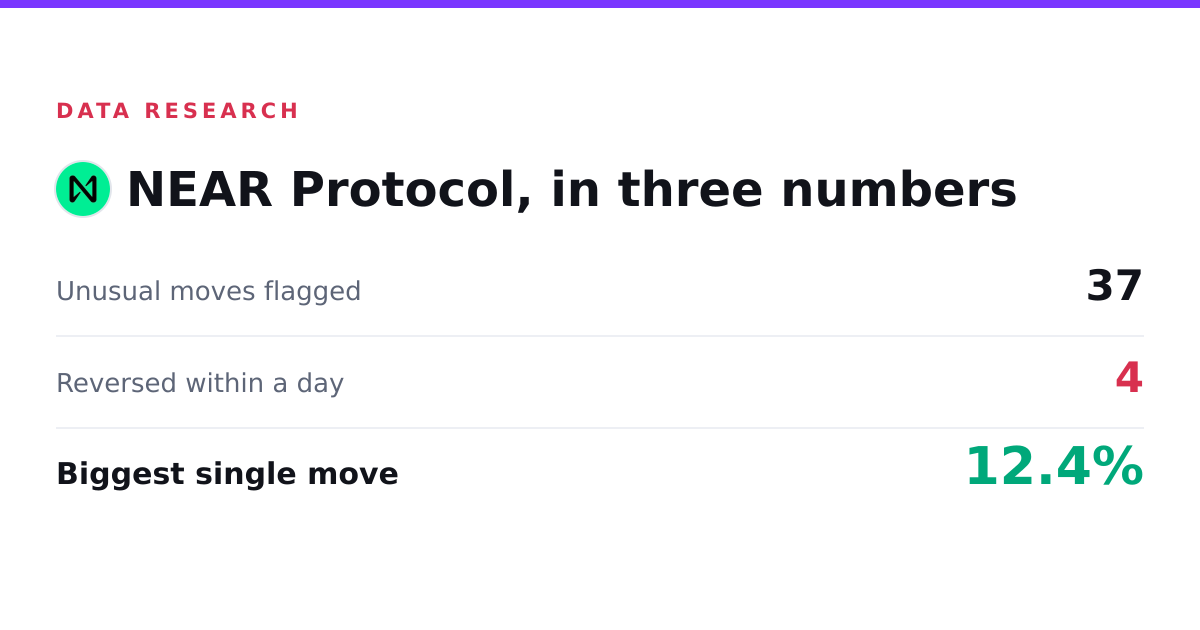
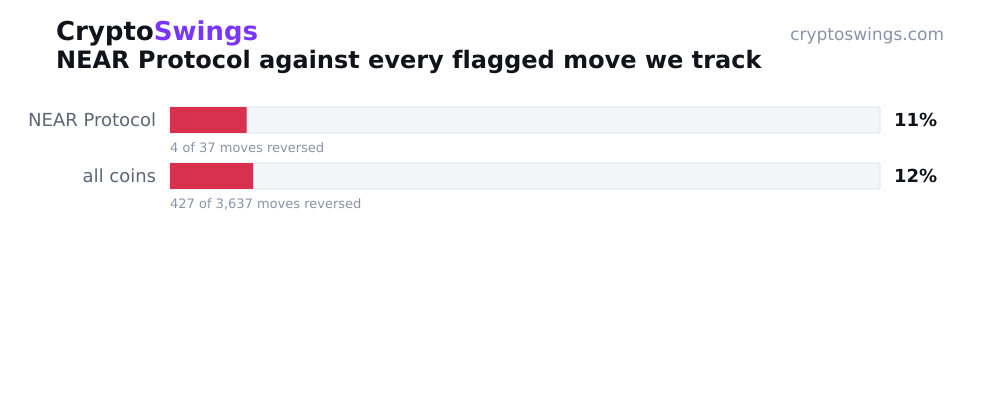
Thirty-seven times over roughly ten weeks, NEAR Protocol did something big enough to trip the wire. And when the dust settled a day later, only four of those moves had turned around and gone back the way they came.
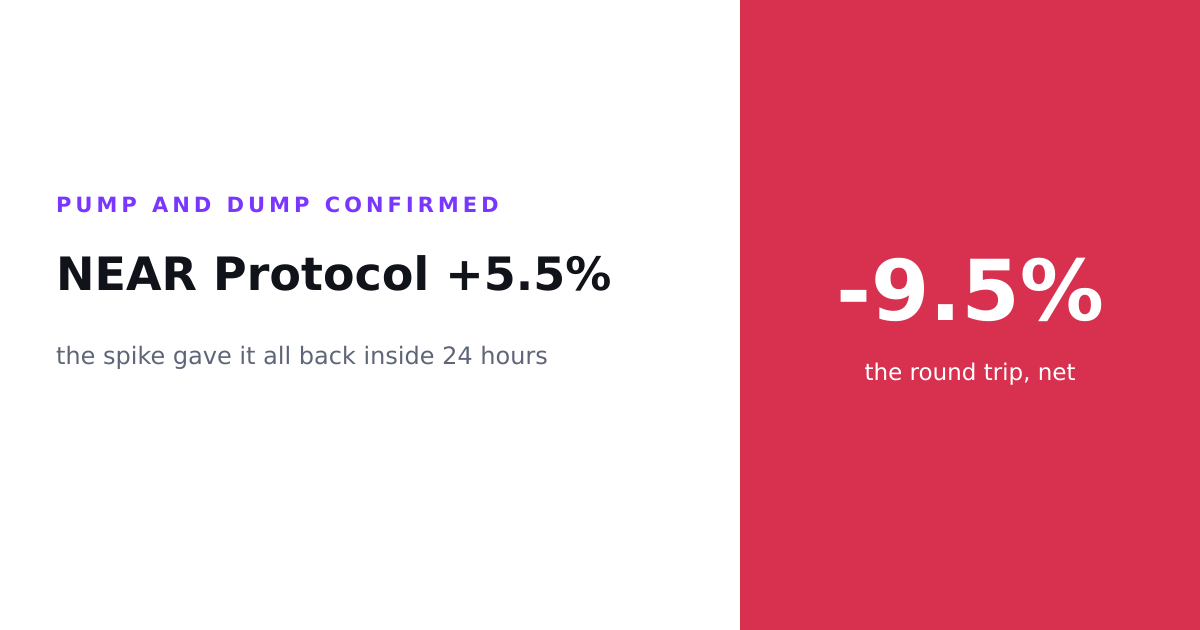
*Previously: NEAR Protocol's 5.5% Rally Ran the Round Trip to Minus 9.5%*
Sit with that ratio for a second. NEAR got loud thirty-seven times between June 10 and August 23, 2026, and on all but four of those occasions the move it made was still standing the next day. Not doubled, not necessarily continued, just not undone. In a market where the reflexive assumption is that every spike is a trap waiting to spring, that is a coin with an unusually good habit of meaning what it says.
The Shape Of A NEAR Move
Strip NEAR's flagged moves down to their measurements and a portrait emerges. The typical unusual move ran about 4.8%. That is a real jolt but not a fireworks show, enough to notice, enough to matter, not the kind of candle that gets screenshotted and passed around.
The biggest of the bunch reached 12.4%. That is the ceiling across the whole stretch, the single loudest thing NEAR did in ten weeks. Which tells you something about the coin's temperament: it moves, it moves often, but it does not tend toward the wild double-digit lurches that smaller and flakier tokens throw off like sparks.
And the direction? Almost dead even. Eighteen of the flagged moves were rallies, nineteen were sell-offs. One extra sell-off is the entire margin. If you wanted a coin that has no obvious bias toward pumping or dumping when it gets restless, NEAR is auditioning hard for the role. Up days and down days showed up in near-equal measure, and neither camp got to claim the coin's personality.
A Follow-Through Better Than Average
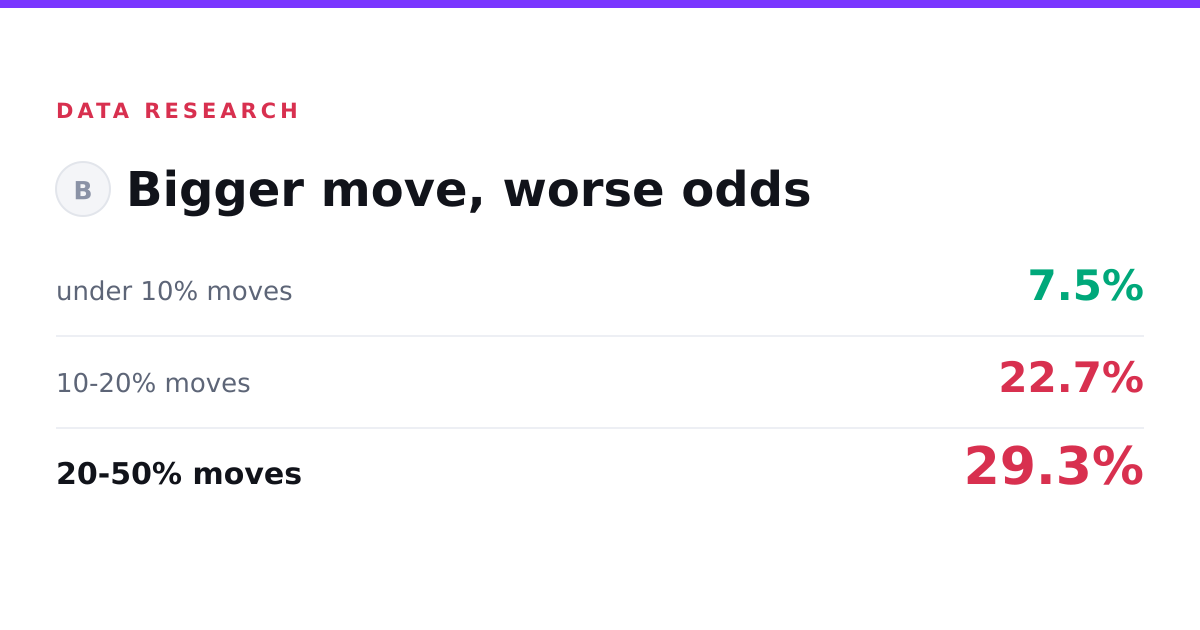
Here is where NEAR gets genuinely interesting. Across every coin being tracked, the reversal rate sits at 11.7%, roughly one flagged move in nine gets walked back within a day. That is the baseline, the ambient noise of a market that loves to fake people out.
NEAR came in at 10.8%.
Slightly below average, which does not sound like a headline until you remember what the average represents. NEAR is a large, heavily traded coin, and large coins are exactly the ones you would expect to hold their moves, deep liquidity, fewer thin-order-book head fakes, less room for a single seller to yank the price around and hand it back. NEAR did not just meet that expectation. It edged past it.
The pattern here is steadiness. When NEAR broke out of its range, the break stuck a little more reliably than the typical coin's did. Four second thoughts out of thirty-seven is a coin that rarely regrets the room the day after. Whatever forces were pushing the price when it got flagged, they mostly kept pushing, or at least did not slam into reverse before the next day rolled around.
What Counts As Unusual, And How You Grade It
A quick word on the machinery, because the numbers only mean something if you know what they are counting.
Every figure here comes from automatically flagged unusual moves, price action sharp enough to stand out from NEAR's ordinary background chop. A flag is not a judgment. It is a flashlight pointed at a moment where the coin did something out of character, big enough and fast enough to warrant a look.
The outcome gets settled by checking the real market price one day later. Did the move hold, extend, or unwind? A move counts as reversed when the price gives back the ground it took and heads the other way. Everything is measured against actual traded price, not a model or an estimate. So when the record says NEAR reversed four times, it means four flagged moves were undone in the plain, literal sense: the coin moved, then moved back.
This particular dataset comes from CryptoSwings, which logs these flagged moves and grades each one against the market a day out. No opinions in the pile. Just what happened, and what happened next.
Did NEAR Protocol Reverse Its Moves? Here Is The Number
If you came looking for a straight answer to a straight question, does NEAR Protocol tend to reverse its big moves?, the record says no, not often. It reversed 10.8% of them, four flagged moves out of thirty-seven across the June-to-August stretch. That is marginally below the 11.7% you would see averaged across all tracked coins.
In plain terms: when NEAR made a notable move over this window, roughly nine times in ten that move was still intact the next day. The coin's default was follow-through, not takeback. That is not a guarantee about the next move, and it is not a promise about tomorrow. It is what the last thirty-seven big moves actually did.
For a coin whose name is one letter away from a promise about how close something stays, the follow-through is almost too on the nose. NEAR moved, and NEAR mostly stayed near where the move left it.
Where The Record Stops Talking
Now the honest part, because a clean number can flatter itself if you let it.
This is a record of what happened. It is not a forecast, and it cannot become one no matter how tidy the ratio looks. Thirty-seven moves is a solid sample for a ten-week stretch, but it is still ten weeks, June 10 through August 23, 2026 - and a window is a window. Push the boundaries out or slide them forward and the picture can shift. A single volatile fortnight can rewrite a reversal rate that took two months to settle.
The comparison to the market-wide 11.7% is a comparison of averages, and averages flatten a lot of texture. NEAR sitting just under the baseline tells you the coin was slightly stickier than the typical tracked token over this window. It does not tell you the next flagged move will hold. Each move is its own event with its own reasons, and the record grades them after the fact, never before.
There is also the matter of what gets counted. Buckets with too few cases to mean anything get left out rather than dressed up as signal, a handful of moves is a story you cannot tell honestly, so it does not get told. What survives into these figures is the stuff with enough weight to stand on. That is a feature, but it also means the record is quiet about the edges.
And the whole thing rests on that one-day-later measurement. A move that held for a day and then unwound on day three counts as held here, because the grade is taken when the grade is taken. Stretch the measurement horizon and some of NEAR's thirty-three survivors might look different. Shorten it and others might. The window is fixed, the outcome is fixed to it, and everything downstream inherits that choice.
So take NEAR's ten-out-of-a-hundred reversal rate for exactly what it is: a clear, measured account of how a large coin behaved when it got loud over one specific stretch. The coin moved thirty-seven times. It kept its footing on thirty-three of them. The reversals were the exception, not the rule, and for a market that assumes the opposite by default, that is the whole story worth telling.
Whether NEAR keeps that steadiness is a question the record does not answer and never claimed to. It only tells you what already happened. And what already happened is a coin that got flagged again and again, and blinked barely at all.