Shiba Inu (SHIB) Price Moves: 63 Flagged, 1 Reversed
One Flag Out of Sixty-Three Changed Its Mind
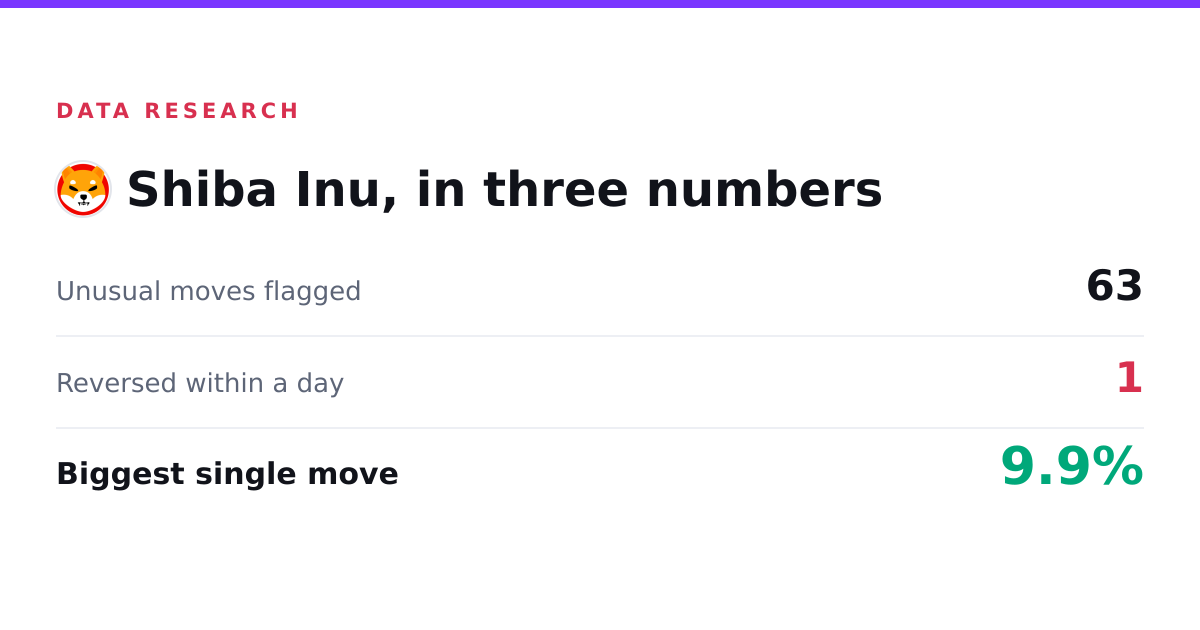
Start on November 16, 2026, the last day the alarm went off. By then Shiba Inu had done this sixty-three separate times, stretching all the way back to June 5. Sixty-three unusual moves flagged over more than five months. And in all that stretch, exactly one of them reversed a day later.
*Previously: Shiba Inu Runs 85.8% While Pocket Network Springs a Leak*
One.
That is the whole story in a single ratio, and it is worth saying out loud before we unpack it: whatever SHIB does when it trips the wire, it tends to still be doing a day later. This is not a coin that lures you in and then yanks the rug. It is a coin that picks a direction and, overwhelmingly, keeps walking.
A Sea of Sell-Offs, With the Occasional Green
Now the shape of those moves, because sixty-three flags is a decent sample and the texture matters.
The typical flagged move came in around 4.4 percent. Not dramatic by micro-cap standards, but SHIB is not a micro-cap. It is one of the most heavily traded dog coins in existence, and a 4.4 percent lurch on something that size involves a lot of money changing hands. The biggest single flagged move topped out at 9.9 percent. That is the ceiling across the entire five-month record. No moonshots, no vertical candles, no chart that suddenly looks like a cliff. SHIB's wild days are, by the standards of this corner of the market, fairly well-behaved.
The direction split is where it gets interesting. Of the sixty-three flagged moves, 27 were rallies and 36 were sell-offs. So the alarm went off a little more often on the way down than on the way up. Red edged out green. If you were watching SHIB across those months and felt like it was taking more punches than it was throwing, the record backs you up.
The Coin That Keeps Its Word
Here is the comparison that makes the whole thing stand out.
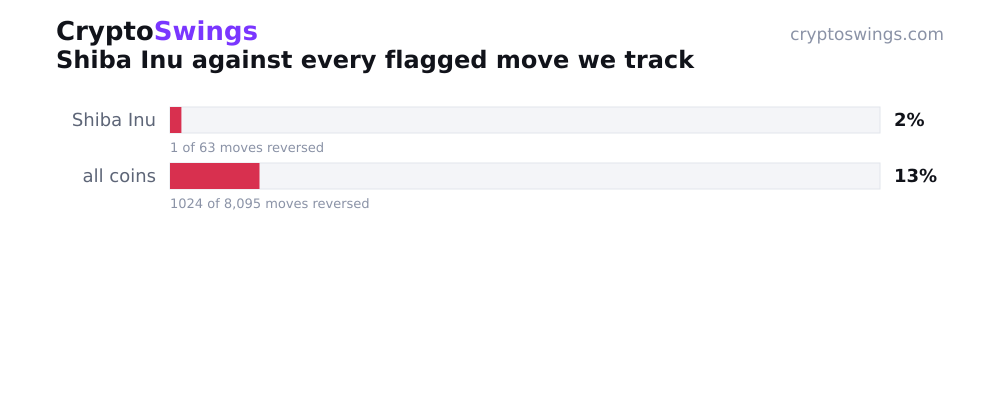
Across every coin being tracked, the reversal rate, the share of flagged moves that turn around and go the other way within a day, sits at 12.6 percent. Call it one flagged move in eight that changes its mind. That is the baseline. That is normal.
Shiba Inu's reversal rate is 1.6 percent.
Sit with the distance between those two numbers. The average coin reverses roughly eight times as often as SHIB does. Most things on the board will fake you out now and then, a spike that melts, a drop that snaps back. SHIB, by this measure, almost never does. Sixty-three flags, one reversal. That is not a coin that fakes you out. That is a coin that commits.
That consistency cuts both ways, and it is worth being honest about it. A low reversal rate does not mean the moves are kind. Thirty-six of them were sell-offs, and a sell-off that does not reverse is simply a sell-off that stuck. "Reliable" here means the move holds its direction, not that the direction is one you wanted. SHIB follows through whether it is climbing or sliding.
How a Move Earns a Flag
A word on what any of this means, because the numbers are only as good as the definition behind them.
Every figure here comes from automatically flagged unusual moves, price action that stands out sharply enough from the ordinary noise to trip a detector. When a move gets flagged, the outcome is not judged on the spot. It is measured against the real market price one day later. Did the move hold, or did it unwind? That is the entire test. Hold, and it counts as a move that stuck. Unwind, and it counts as a reversal.
So the 1.6 percent reversal rate is not a mood or an impression. It is sixty-three flagged events, each one checked against where the price actually sat a day after. Sixty-two held their ground. One did not. No interpretation, no spin, just the before and the after, measured against the tape.
Does Shiba Inu Reverse After a Big Move?
If you came here asking whether Shiba Inu reverses after a big move, the direct answer is: almost never. Its reversal rate is 1.6 percent, against a 12.6 percent average across all tracked coins. Out of sixty-three flagged moves spanning June 5 to November 16, 2026, a single one turned around within a day.
So the short version is that SHIB's flagged moves are about as sticky as they come. When it jumps, it tends to stay jumped. When it drops, and it dropped more often than it climbed, 36 sell-offs to 27 rallies, it tends to stay dropped. The move you see at the flag is, far more often than not, the move you are still looking at a day later. On this record, betting on a snap-back would have been betting against sixty-two outcomes out of sixty-three.
That is unusually clean behaviour for a coin that trades as much as SHIB does. Most assets at least occasionally give back a move. This one, across five months, essentially did not.
What the Record Does Not Promise
Now the fine print, because a number this striking deserves a fence around it.
This is a record of what happened. It is not a forecast. Sixty-two held and one reversed, but that describes the stretch from June 5 to November 16, 2026, and nothing beyond it. A coin that held its moves for five months is not under any obligation to keep doing so. The sixty-fourth flag has no memory of the first sixty-three.
The window is also fixed. Every outcome here was measured one day later, no more. A move that held firm after a day might have wobbled on day two or day three, this data simply does not look that far, so it cannot say. "Did not reverse within a day" is a precise claim, and it is also a narrow one.
And the measurement only knows what crossed the threshold to get flagged. Ordinary days, the quiet drift that never tripped the detector, do not appear in this record at all. Sixty-three unusual moves is what we are counting. The rest of SHIB's trading life, the uneventful majority, is outside the frame entirely.
What would change the picture? More reversals, for a start. Right now the ratio rests almost entirely on moves that held, and it would only take a run of snap-backs to drag that 1.6 percent up toward the pack. A longer measurement window could tell a different story too, since holding for a day and holding for a week are not the same promise. And a shift in that direction split, more rallies, fewer sell-offs, or the reverse, would change the character of what SHIB is doing even if the reversal rate stayed put.
For now, though, the record reads about as plainly as a record can. Sixty-three flags. Thirty-six sell-offs, twenty-seven rallies, a typical move around 4.4 percent and a ceiling of 9.9. And one lone reversal in the whole lot, against an average coin that reverses eight times as often. Shiba Inu, over these five months, was a lot of things. Indecisive was not one of them.