Sui (SUI) Price Moves: 51 Flagged, 2 Reversed
A Coin That Mostly Means It
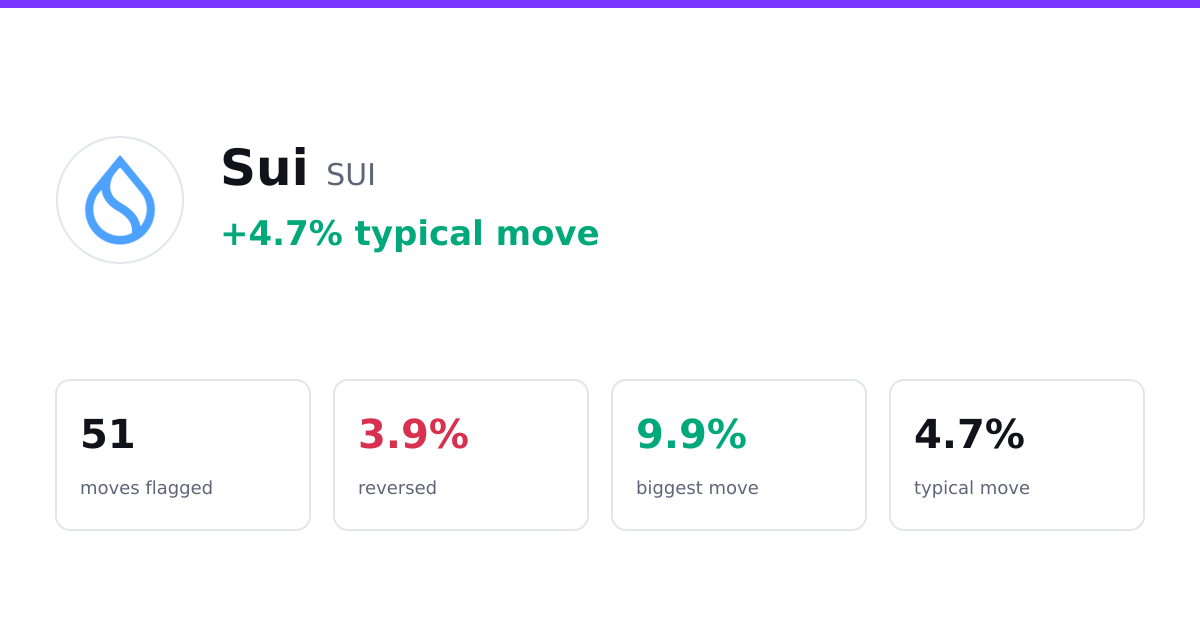
Here is Sui's record in a single line: 51 unusual moves flagged between June 5 and October 5, 2026, and of those, exactly two reversed.
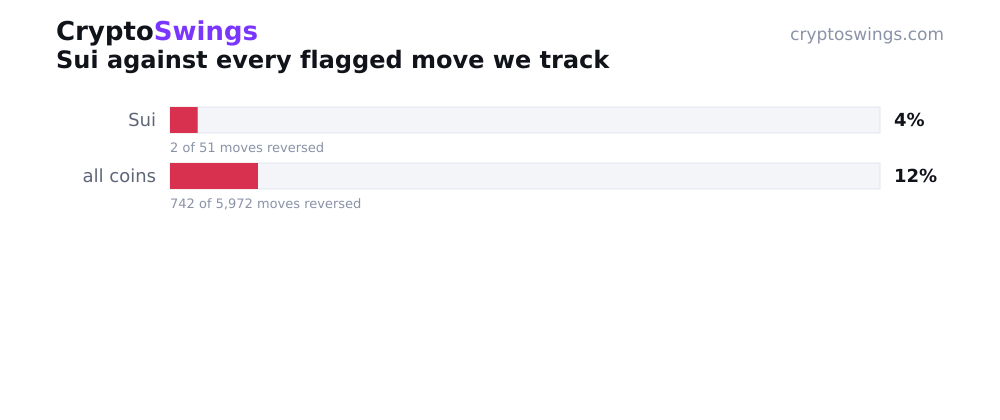
That is the whole story in miniature, but it is worth slowing down, because a number like that is unusual in its own right. Most coins that make big moves are busy taking at least some of them back. Sui, over four months, mostly kept what it grabbed and kept what it lost. When this coin moved, it tended to stay moved.
The Shape Of A Sui Move
Sui is not a coin that deals in theatrics. The typical flagged move came in at 4.7%, which is a respectable jolt without being the sort of thing that empties a room. There were no triple-digit candles here, no decimal points to read twice. The biggest single move on record was 9.9%, a number that barely clears the line into double digits and then stops, politely, like it knows its limits.
So picture the opposite of a fireworks display. Picture a coin that moves in solid, legible steps, each one a few percent at a time, none of them trying to go viral.
The split between up and down was almost even. Of the 51 flagged moves, 27 were rallies and 24 were sell-offs. That is about as balanced as a four-month stretch gets. Sui did not spend the period relentlessly climbing or bleeding in one direction. It went up a little more often than it went down, and the difference is small enough that you could call it a coin genuinely undecided about where it wanted to be.
What stands out is not the direction. It is the follow-through. Whether Sui rallied or sold off, the move usually held.
When Steadiness Becomes The Story
Now the comparison that gives the whole thing its weight.
Across every coin tracked, the reversal rate sits at 12.4%. That is the baseline, the background hum of a market that loves to give something and then quietly reclaim part of it a day later. Roughly one flagged move in eight comes undone across the board.
Sui's reversal rate is 3.9%.
Read that against the 12.4% and the gap does the talking. Sui reversed its flagged moves at well under a third of the pace you would expect from the field. Two walkbacks out of fifty-one. The average coin, over the same count of moves, would have given back a meaningfully larger share.
This is the part worth sitting with. A low reversal rate does not mean a coin is tame, and it does not mean a coin is safe. It means something narrower and more useful: when Sui made an unusual move during this window, that move tended to be real in the sense that it was still there the next day. The coin was not in the habit of faking a direction and then thinking better of it. It committed.
That is a different personality from the micro-caps that spike on a Tuesday and are underwater by Wednesday morning. Sui is a larger, calmer animal. It moves less dramatically, and when it does move, it means it more often than most.
How A Move Earns The Label
Worth being precise about what is actually being counted here, because "unusual move" is doing a lot of quiet work.
Every figure in this study comes from moves that were flagged automatically, not hand-picked after the fact. A price shift large enough to stand out from the coin's own ordinary noise gets tagged as unusual the moment it happens. No human decided afterward which candles looked interesting. The flag fires on its own.
Then the outcome gets measured against the real market price one day later. That is the entire test. Did the move hold, or did the price come back and undo it? A flagged move counts as reversed when the price one day on has walked back the thing that got it flagged in the first place. Everything else, every move that held its ground or kept running, falls on the other side of the ledger.
So when the record says two of 51 reversed, it is saying that 49 times, the move was still standing a day later. This is the kind of plain-spoken bookkeeping that platforms like CryptoSwings run across whole rosters of coins, and Sui's page in that ledger is a notably stubborn one.
Does Sui Reverse Its Price Moves?
Here is the question in plain form: when Sui makes a big move, does it tend to take it back?
The direct answer is no, not usually. Sui reversed just 3.9% of its 51 flagged moves over the four-month window, meaning only two of them came undone a day later. The other 49 held. Against a market-wide reversal rate of 12.4%, Sui is one of the coins least inclined to walk back what it does.
That is the honest, number-backed version. If you were expecting a coin that lures you in with a move and then snatches it away, the record does not describe one. Sui's flagged moves, rally or sell-off, mostly stuck. The coin's habit over this stretch was to go somewhere and then stay there, which is quietly one of the more reliable behaviours a volatile asset can show.
It is not the flashiest trait. Nobody writes songs about a coin that follows through. But for anyone trying to read the tape, a low reversal rate is a genuine data point: it says the moves this coin made during the window were, more often than not, the real thing rather than a head-fake.
What The Record Can And Cannot Tell You
Now the part that keeps everyone honest.
This is a record of what happened. It is not a map of what happens next. Those 51 flagged moves, the two reversals, the 3.9% rate, all of it describes a fixed stretch of calendar from June 5 to October 5, 2026, and nothing outside it. A coin that held its moves beautifully for four months can wake up tomorrow and behave like a different asset entirely. Past steadiness is a description, not a promise.
The window is closed and finite. It does not include the move Sui made this morning, and it cannot. The sample is what it is: 51 events, which is a solid count but not an enormous one. A single unusually chaotic month would push that reversal rate around. Two reversals is a small enough number that a couple more in the next stretch would visibly change the figure.
There is also the matter of what got left out. Where the data thinned out too far to say anything trustworthy, those buckets were excluded rather than reported on a handful of cases pretending to be a trend. That keeps the headline numbers honest, but it also means this is a study of the parts where there was enough evidence to speak, not a complete accounting of everything the coin ever did.
And the measurement itself is deliberately narrow. The outcome is judged exactly one day after the flag, against the real market price. A move that held for a day and then unwound on day three would still read as "held" here. A move that briefly dipped and recovered within the day would still read as it stood at the checkpoint. The one-day test is clean and consistent, which is its strength, but it only ever sees one slice of time.
What would change the picture? More data, mostly. A longer window, a fresh wave of flagged moves, a stretch of genuine turbulence. Any of those could pull the reversal rate up toward the market's 12.4% or push it even lower. For now, across the four months on the books, the verdict is simple and a little unglamorous.
Sui got flagged fifty-one times in four months and walked back exactly two of them. Whatever else it did, it was not a coin that changed its mind.