Worldcoin (WLD) Price Moves: 40 Flagged, 3 Reversed
A Coin That Mostly Meant It
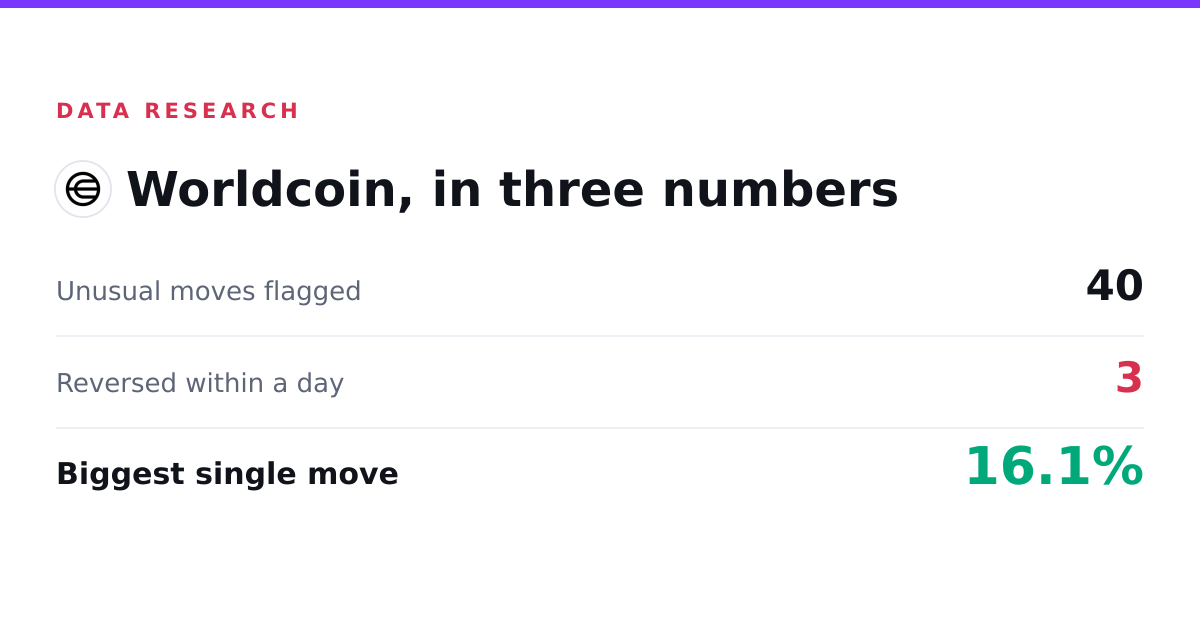
If you are scanning the altcoins trending across a summer chart and you want the one that keeps its footing, here is the number that does the talking: Worldcoin flagged forty unusual moves between June 5 and August 16, 2026, and only three of them reversed within a day. That is a coin that finished the sentence it started, more often than not.
*Previously: Worldcoin Kept Setting Off the Alarm All Week Long*
Set the scene. Ten weeks of tape. Forty times the price did something worth flagging, a jolt sharp enough to stand out from the ordinary noise. And when you follow each of those jolts to the next day and ask a simple question, did it hold, or did it snap back, the answer comes back the same way thirty-seven times. It held. Three moves turned around. The rest kept walking in the direction they set off in.
That is a low return rate for the small end of the market, where snapbacks are practically a house style. WLD spent the summer doing something quieter and rarer: following through.
The Shape of the Summer
Now the texture of it. The typical Worldcoin move in this window ran about 4.9 percent, a real shove, not a tremor, but nothing that would knock the wind out of anyone. These were mid-sized moves, the kind that register clearly without dominating the chart.
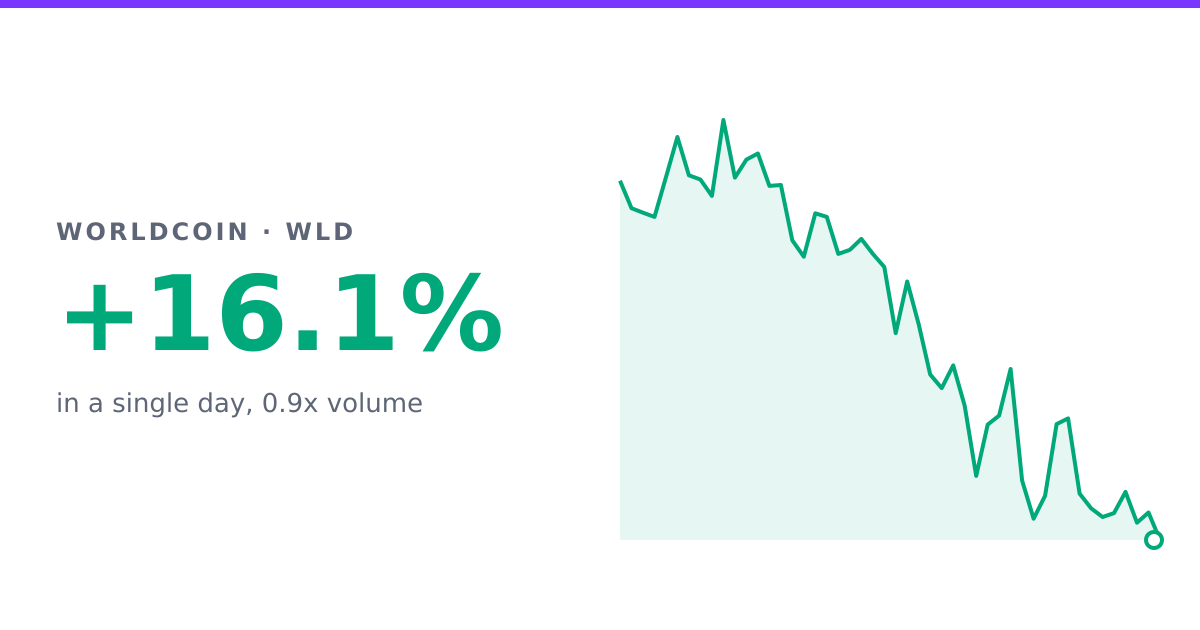
The biggest one topped out at 16.1 percent. That is the outlier, the single sharpest lurch across the whole stretch, and next to some of the triple-digit fireworks that show up elsewhere on the board, it is almost polite. Worldcoin did not deal in the spectacular this summer. It dealt in the frequent and the moderate, forty times over.
And here is the split that gives the period its mood. Of the forty flagged moves, fifteen were rallies and twenty-five were sell-offs. The red outnumbered the green by a comfortable margin. This was not a coin on a tear. It was a coin under steady downward pressure, tipping lower more often than it climbed, and, crucially, when it tipped, it tended to stay tipped.
That combination is the whole story in miniature. More sell-offs than rallies, and very few of either taken back. Worldcoin was not bouncing. It was drifting with conviction.
Steadier Than Its Weight Class
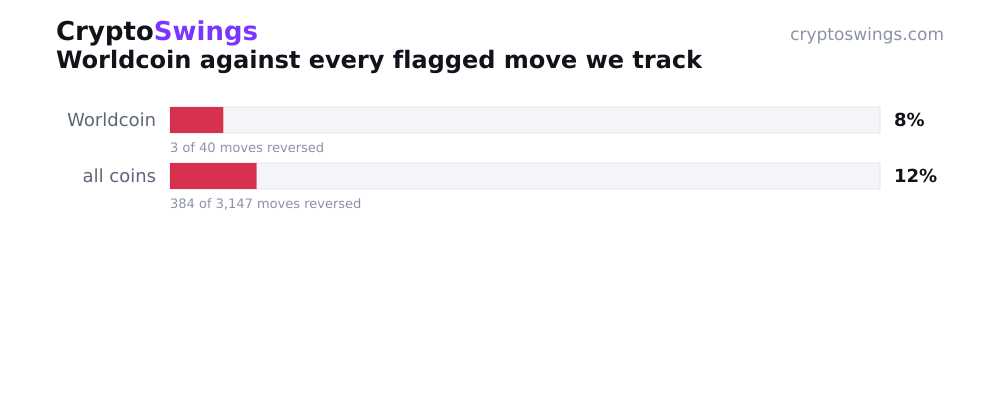
Here is where the number earns its keep. Across every coin tracked, the average reversal rate sits at 12.2 percent. Worldcoin came in at 7.5 percent, meaningfully under the field.
Translate that. If you flagged a sharp move on a random coin of this profile and asked whether it would still be standing the next day, the base expectation is one snapback in roughly every eight flags. Worldcoin beat that. It walked back three out of forty when the typical coin would have walked back more.
That does not make WLD calm, twenty-five sell-offs across ten weeks is not the resume of a serene asset. But it makes it committed. When Worldcoin moved, the move tended to be the real thing rather than a head-fake that dissolved by the next session. For a coin at the smaller end of the board, where the fake-out is close to a native language, that is a genuinely distinctive fingerprint.
The pattern reads less like a coin second-guessing itself and more like one that picks a direction and leans into it. Whether that direction was up or down was another matter, and mostly, this summer, it was down.
How the Flags Get Set
Worth pausing on what any of this actually measures, because the method is plain and the plainness is the point.
Every figure here comes from moves flagged automatically as unusual, price action sharp enough to break out of the ordinary background chop. A move gets caught, and then its outcome is checked against the real market price one day later. Did it hold its ground, or did it hand the move back? That is the entire test. No interpretation, no forecasting, just a before and an after.
So "reversed" has a precise meaning. It is not a slow bleed over a week or a change of heart a month down the line. It is a move that flips within a day of being flagged, the fast recant, the candle that looked convincing at flagging and had reconsidered by the next check. Thirty-seven of Worldcoin's forty moves passed that test. Three did not.
That is why the reversal rate is such a clean signal. It is not asking whether WLD went up or down over the summer. It is asking, every single time the price jumped, whether the jump was for real. And forty times over, Worldcoin's answer was mostly yes.
What Altcoins Trending Like This Are Actually Doing
If you searched for altcoins trending and landed on Worldcoin, the question underneath is usually the same one: when this thing moves, does the move stick, or does it evaporate?
The direct answer: Worldcoin's moves stuck. It reversed just 7.5 percent of its forty flagged moves within a day, against a 12.2 percent average across all tracked coins. When WLD jumped this summer, the jump was far more likely to hold than to unravel.
That is the useful thing to know about an altcoin trending this way. The follow-through rate is the tell. A coin that reverses constantly is a coin where a sharp move tells you almost nothing about the next day. A coin that reverses rarely, three times in forty, is one where the move carries information. Worldcoin, over these ten weeks, was the second kind.
Pair that with the directional lean and you get a fuller picture. Twenty-five sell-offs to fifteen rallies, and most of them holding, means the summer's drift had staying power. This was not a coin whipsawing traders with fake breaks and fake breakdowns. It was a coin that leaned lower and largely stayed there. Boring, maybe. But legible.
Where the Record Goes Quiet
Now the honest part, because a clean number can flatter itself if you let it.
This is a record of what happened, not a map of what comes next. Forty flags across ten weeks describe a stretch that already closed on August 16. They do not promise the next flag behaves like the last forty. A coin that followed through all summer can start snapping back the moment conditions shift, and nothing in this data would see it coming, the record only knows the past it was built from.
The window is fixed, too. Move the start or end date and the mix changes. A different ten weeks might have skewed toward rallies, or thrown up a move far bigger than that 16.1 percent peak, or reversed at a rate closer to the field average. This is one slice, cut where it was cut.
And a genuinely low case count comes with its own caveat. Three reversals is three reversals. A single extra snapback nudges the percentage more than it would on a coin with hundreds of flags, so the 7.5 percent figure should be read as a summer's tendency, not a law. Where a reading rests on too few cases to mean much, it is better left out than dressed up.
What would change the picture? More time, more flags, a different market regime. Any of those could pull Worldcoin's reversal rate up toward the pack or push it further below. For now, the record says one clear thing: across forty unusual moves this summer, Worldcoin followed through on all but three. That is not a forecast. It is a fingerprint, a coin that, when it moved, mostly meant it.