Zcash (ZEC) Price Moves: 39 Flagged, 2 Reversed
Two Out of Thirty-Nine
Two.
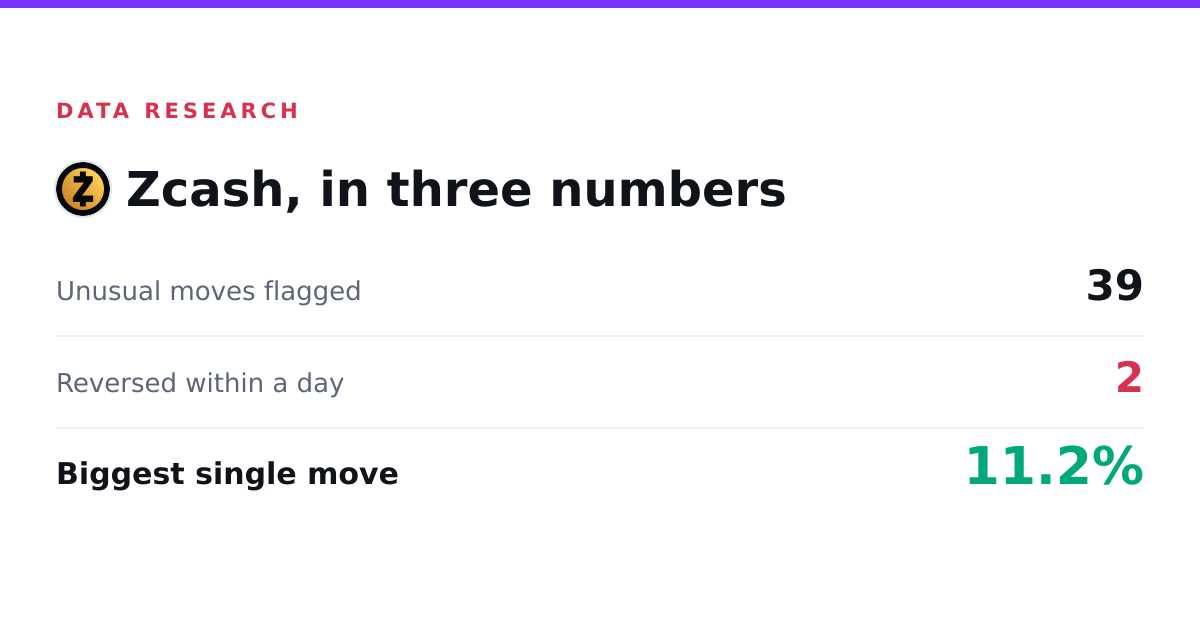
Out of thirty-nine flagged moves stretched across ten weeks, Zcash reversed exactly two of them. Let that sit for a second. Nearly every time this coin did something unusual between June 5 and August 17, 2026, whatever it started, it finished. The move landed and stayed landed.
*Previously: Zcash Slides 8.8% and the Privacy Coin Goes Quiet Again*
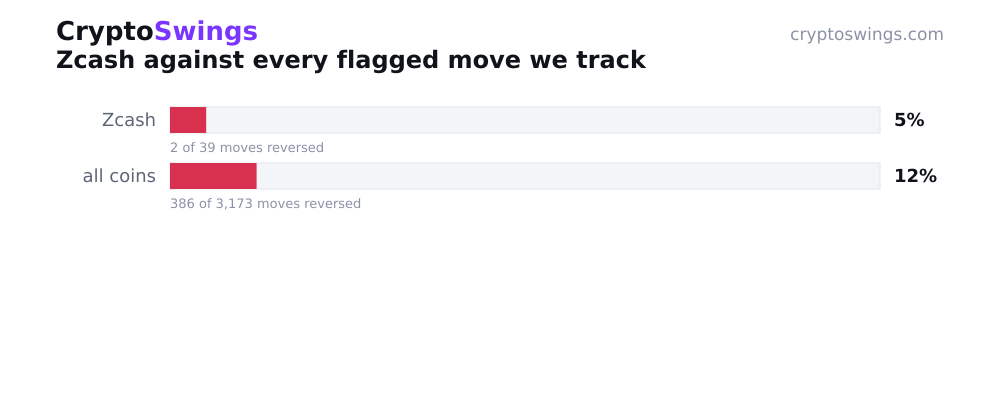
That works out to a reversal rate of 5.1 percent. In a market where flagged moves routinely turn around and hand the day back before you have finished reading about them, a coin that follows through on almost everything it flags is the rare kind of steady. Zcash did not flirt. It committed.
The Shape of a ZEC Move
So what did those thirty-nine moves actually look like?
Nothing wild, is the honest answer. The typical flagged move ran about 5 percent, the kind of jolt that gets a coin noticed without setting anything on fire. The biggest single move over the whole stretch was 11.2 percent. That is your ceiling. No triple-digit moonshots, no gut-drop collapses, no candle that needed its own headline. Zcash spent ten weeks operating inside a fairly tight band and, more to the point, staying inside it after the fact.
The direction split was almost a dead heat. Twenty of the flagged moves were rallies, nineteen were sell-offs. That is about as evenly balanced as a coin can get without a coin toss. Zcash was not building a one-way trend or leaning green or bleeding red. It pushed up. It pushed down. And whichever way it pushed, it tended to hold the ground.
That balance matters for reading the reversal number. A coin that only rallies can look sticky just because the tape happens to be friendly. Zcash was flagging in both directions and still barely walking anything back. The follow-through cut across the board, not just the up days.
Steadier Than the Room
Here is where the 5.1 percent starts to earn its keep.
Across every coin tracked, the average reversal rate sits at 12.2 percent. That is the baseline, the middle of the field, the number a flagged move is generally measured against. Zcash came in at 5.1 percent, less than half of that. So this is not just a coin that held its moves. It held them noticeably better than the typical name on the board.
Think of it this way. When a flagged move hits, the safe assumption is that a meaningful slice of them will change their mind within a day. That is baked into the average. Zcash quietly ignored the assumption. It took the unusual move, sat on it, and let it become the new normal about nineteen times out of twenty.
Two reversals out of thirty-nine. That is not a coin that changes its mind much.
None of that says the moves were large. They were not, capped at 11.2 percent and clustered around 5. What Zcash offered was not size but reliability. When it moved, the move meant something the next day. In a market full of candles that promise a lot and refund half of it by morning, low drama plus high follow-through is its own kind of interesting.
How a Move Gets Counted
Worth being clear about what is being measured here, because the whole story rests on it.
Every figure comes from automatically flagged unusual moves. A move gets flagged when the price does something out of the ordinary, a jump or a drop that stands out from the coin's usual behaviour. That is the entry ticket. Not every wiggle qualifies, only the ones sharp enough to register as unusual.
Then comes the part that decides everything. The outcome of each flagged move is checked against the real market price one day later. If the move held its ground, it counts as follow-through. If the price gave the move back, it counts as a reversal. That is the entire scoring system, and it is measured against actual price, not an estimate or a model.
So when we say Zcash reversed two out of thirty-nine, that is not a vibe. It is thirty-nine flagged events, each one checked a day after it landed, with two of them found to have turned around and thirty-seven found to have stuck. The data on CryptoSwings that this study draws from is a plain ledger of those outcomes, nothing fancier.
Do Zcash Price Moves Tend to Stick or Reverse?
If you typed some version of "do Zcash price moves reverse" into a search bar, here is the direct answer: they overwhelmingly stick. Of thirty-nine flagged moves between June 5 and August 17, 2026, only two reversed within a day, a reversal rate of 5.1 percent.
Put the other way, roughly nineteen of every twenty unusual Zcash moves in this window held their direction to the next day. Against an all-coin average of 12.2 percent, Zcash reversed less than half as often as the typical tracked name. The moves themselves were modest, around 5 percent on average and no bigger than 11.2 percent, and split almost evenly between twenty rallies and nineteen sell-offs.
So the short version: over this stretch, a flagged Zcash move was far more likely to be the real thing than a head-fake. Small, balanced, and unusually persistent.
Where the Data Stops
Now the part that keeps everyone honest.
This is a record, not a road map. Everything above describes what Zcash did between June 5 and August 17, 2026, and nothing about what it will do tomorrow. Thirty-nine flagged moves is a real sample, enough to see a pattern, but it is a fixed window with a start and an end, and a coin's behaviour can shift the moment the window closes. A steady stretch is not a permanent trait.
Two reversals is also a small number in absolute terms, and small numbers are easy to over-read. The 5.1 percent rate is striking against the 12.2 percent average, but it rests on those two turnarounds. A slightly different ten weeks, a few more moves that changed their mind, and that gap narrows. The pattern is clear for this window. It is not a law.
There is a scope limit too. This study looks only at moves large enough to get flagged as unusual, and it measures outcomes at a single checkpoint one day out. It does not track what happened two days later, or a week later, or how a move behaved in the hours before it settled. A flagged move that held for a day might have wobbled the day after. That is outside what this data sees.
And the reliability here is about direction, not magnitude. A move that stuck was a move that did not reverse. It says nothing about whether the size was worth anyone's attention beyond the flag itself, and the sizes on offer were modest to begin with.
What would change the picture? More time, mostly. A fresh batch of flagged moves, a run of turnarounds where there were almost none, or a jump in the size of the moves would all rewrite the profile. Markets do not owe their past behaviour to their future.
For this window, though, the read is clean and a little unusual. Zcash moved often enough to notice, evenly enough to stay balanced, and firmly enough that almost nothing it started got taken back. Thirty-nine flags, two second thoughts. In a market that loves to change its mind, that is a coin that mostly held its line.