Aave (AAVE) Price Moves: 36 Flagged, 1 Reversed
The broad crypto market spends most of its time doing an unremarkable side-to-side shuffle, and then, every so often, one coin decides to plant its feet. This is a story about the planting.
One Reversal In Ten Weeks
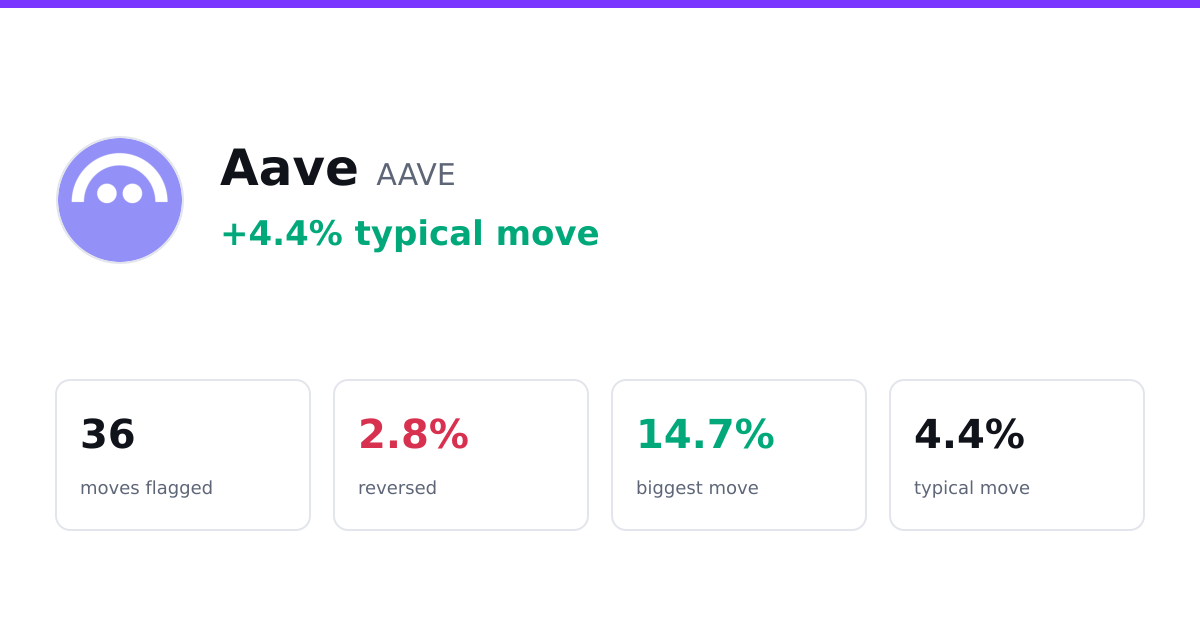
Here is Aave's record, stripped to a single sentence: 36 unusual moves flagged between June 5 and August 19, 2026, and exactly one of them reversed. One. Out of thirty-six.
*Previously: Aave Rips 14.7% and Leaves the Tape Guessing*
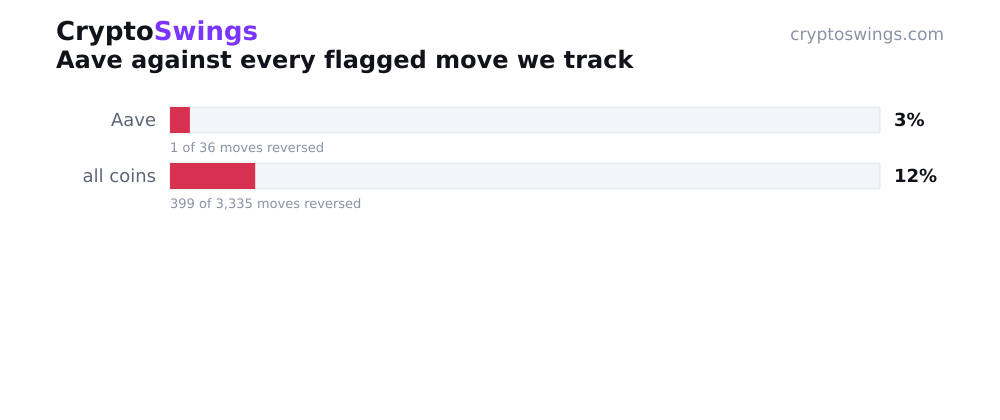
That works out to a reversal rate of 2.8 percent, which is another way of saying that when this coin moved sharply over those ten weeks, it almost always stayed moved. Whatever direction it chose, it committed. One walk-back out of thirty-six is not a coin that changes its mind.
Most assets are far twitchier than that. Aave, over this stretch, behaved like it had somewhere to be and no interest in doubling back.
The Anatomy Of An Aave Move
Size first, because size sets the scene.
The typical flagged move on Aave came in around 4.4 percent. That is a real jolt, enough to wake up anyone watching the chart, but it is not the stuff of legend. It is a coin doing decisive things at a moderate volume, not a fireworks show.
The biggest single move over the window was 14.7 percent. That is the headline candle, the one that would have made you sit up straight. But notice how the top end and the typical end are not that far apart. Aave was not a coin that mostly drifted and then detonated once. Its big days were bigger versions of its normal days, not aliens from another chart.
And the direction split is almost dead even. Of the 36 flagged moves, 19 were rallies and 17 were sell-offs. Nineteen up, seventeen down. If you were hoping this was a story about a coin that only knows how to go one way, it is not. Aave went both directions with roughly the same enthusiasm, it just tended to keep going once it started.
That is the quiet through-line here. Not the direction. The follow-through.
Steadier Than Its Neighborhood
Now for the comparison that gives the number its teeth.
Across every coin tracked, the average reversal rate sits at 12 percent. That is the baseline, roughly one in eight sharp moves gets taken back within a day, market-wide. It is the normal amount of second-guessing you would expect from a chart.
Aave came in at 2.8 percent. So against a field that reverses around 12 percent of the time, Aave reversed at a fraction of that. It is not a small edge and it is not a rounding quirk. Over 36 chances to flip, it flipped once. A coin behaving at the market-average rate would have flipped considerably more often.
There is a tidy logic to why larger, more heavily traded assets tend to be steadier: the deeper the pool, the harder it is for a single spike to be a fluke that unwinds by morning. Aave is squarely in that camp here. Its moves, once they happened, had staying power, the kind you would sooner expect from a heavyweight than from a lottery ticket.
The result is a chart that, over these ten weeks, did what it said it was going to do more reliably than almost anything around it.
How A Move Earns The Word "Unusual"
A quick word on the machinery, because a number is only as good as the definition behind it.
Every figure here comes from moves that were automatically flagged as unusual, not every wiggle on the chart, only the ones large enough to stand out from Aave's ordinary background noise. Once a move was flagged, the outcome was checked against the real market price one day later. If the move held up, it counted as follow-through. If the price had swung back the other way, it counted as a reversal.
That is the whole test. Did the sharp move stick, or did it snap back within a day? No interpretation, no mood reading, no story about why. Just a before and an after, one day apart, measured against actual price.
It is a clean, boring, honest little yardstick, and boring is exactly what you want when you are counting things. The behavior data for this look came from CryptoSwings, which logs these flagged moves and their outcomes as they happen.
So, How Often Does Aave Reverse After A Big Move?
If you came here typing some version of "how often does Aave reverse after a big move," here is the direct answer: 2.8 percent of the time, based on 36 flagged moves between June 5 and August 19, 2026, of which exactly one reversed within a day.
That is the number. Everything else is context.
To put it in plain terms, over that ten-week window, when Aave made a sharp move, the overwhelming majority of the time it was still pointing the same way one day later. It reversed once. The direction of any given move was almost a coin flip, 19 rallies against 17 sell-offs, but the tendency to hold the move was not a coin flip at all. It was close to a sure thing, by the standards of this dataset.
Compare that to the market-wide 12 percent and Aave looks less like a coin that fakes you out and more like one that means the move when it makes it. Over these ten weeks, at least, it was one of the more honest charts on the board.
What This Record Cannot Do
Now the part that keeps everyone honest.
This is a record, not a road map. It tells you precisely what Aave did between June 5 and August 19, 2026, and it tells you nothing whatsoever about what it will do tomorrow. A 2.8 percent reversal rate is a fact about the past. It is not a promise about the next flagged move, and treating it like one is exactly the mistake the number cannot protect you against.
The window is fixed. Ten weeks is ten weeks. Stretch the study earlier or later and the picture could shift, a rougher stretch of market, a single violent day, a change in how heavily the coin trades, and that clean little 2.8 percent starts to breathe. One reversal out of 36 is a striking ratio, but it is built on 36 events, and 36 is not infinity. A different sample would tell a different story, and the honest move is to admit you do not know which one until it happens.
There is also the matter of what got left out. Buckets with too few cases to say anything meaningful were excluded rather than dressed up as insight, which is the right call, a number built on almost nothing is worse than no number at all. So this is the sturdy part of the picture, not the whole horizon.
And the test itself is narrow by design. It asks one question, did the move hold one day later, and it ignores everything else. It does not know why Aave moved. It does not care what happened two days out, or two weeks out. A move that held for a day and then unwound later still counts as follow-through here, because that is where the measuring stopped.
What would change the picture? A longer window. A stormier market. A run of reversals that drags that rate back toward the pack. Any of those, and the tidy story gets less tidy.
But for the ten weeks on the books, the read is simple enough. Aave moved 36 times, went both directions doing it, and took almost none of it back. In a market that spends most of its energy changing its mind, a coin that keeps its footing is worth noticing, even if the only thing the record promises is that it happened, and the only thing it happened to be was steady.