Uniswap (UNI) Price Moves: 39 Flagged, 2 Reversed
Two Out Of Thirty-Nine
Start with the number that does the heavy lifting: two.
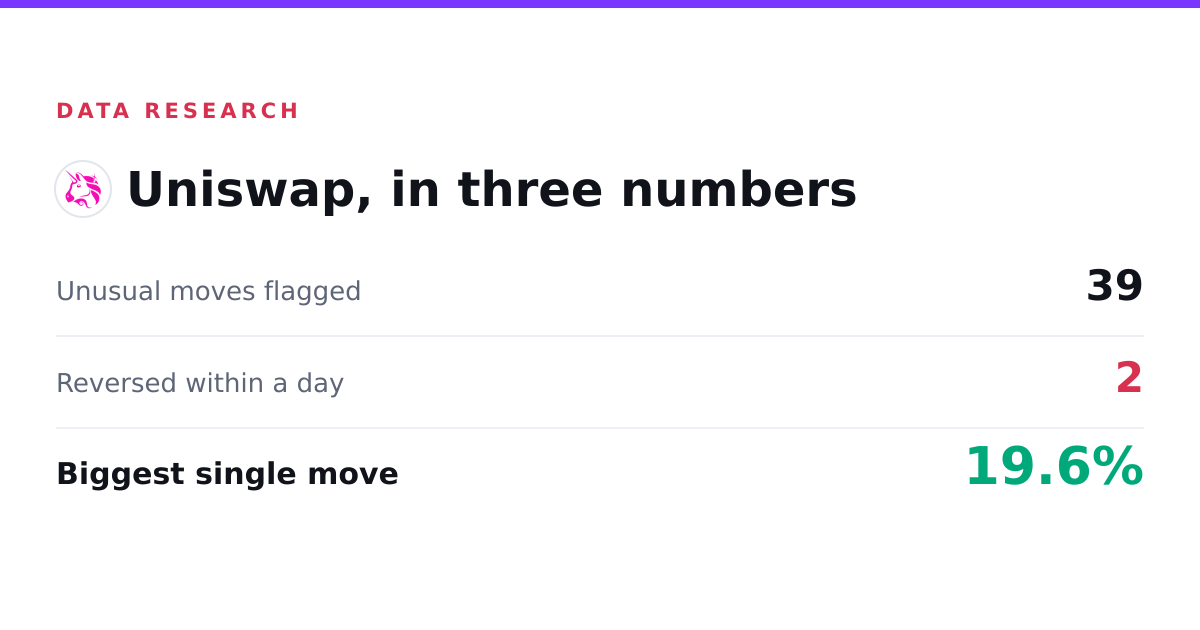
Across nearly three months, Uniswap set off thirty-nine unusual price moves, and exactly two of them came undone the next day. That is the whole headline in a single ratio. Thirty-nine times the chart lurched hard enough to trip an automated wire. Thirty-eight-ish times, give or take, whatever it did on the way up or down was still standing when the dust settled.
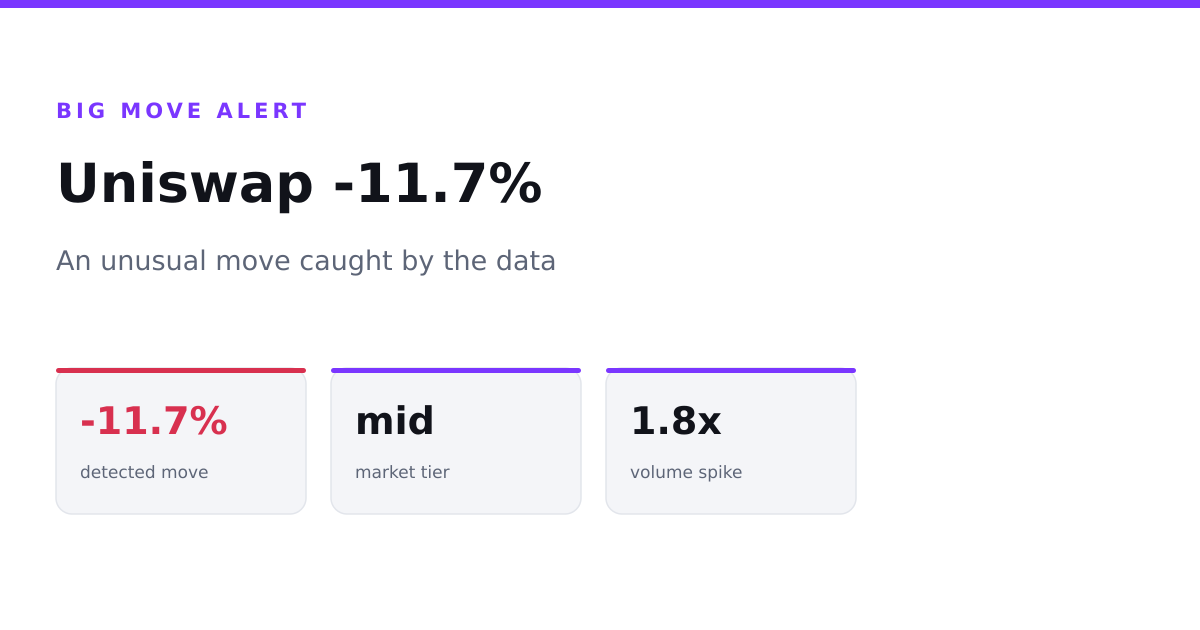
*Previously: Uniswap Slides 11.7% and the Volume Says People Meant It*
For a market that loves to give and then quietly take back, that kind of stubbornness is worth a long look.
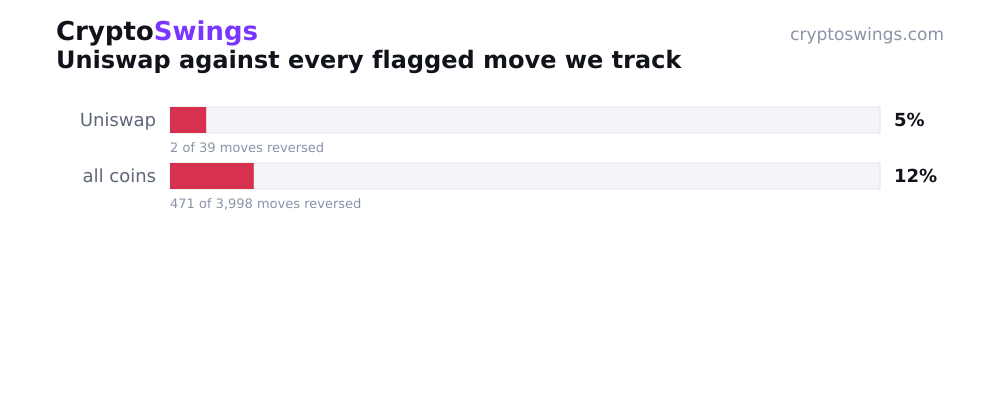
Two reversals out of thirty-nine works out to a reversal rate of 5.1 percent. Hold onto that figure. It is going to keep looking small the longer we stare at it.
The Anatomy Of A Uniswap Move
Uniswap does not deal in fireworks. It deals in follow-through.
The typical flagged move here ran about 5 percent. That is not a candle that gets screenshotted and framed. It is a firm, deliberate step, the kind of move that means something without announcing it to the entire room. Uniswap's whole record reads like a coin that would rather be right than loud.
The biggest single flagged move landed at 19.6 percent. Notable, sure, and by the standards of the smaller names that pinball around the market on any given day, almost polite. Uniswap never printed a candle that made you check the axis twice. Its largest swing was still inside the range where you nod and move on.
Then there is the split, which is about as even as a split gets. Nineteen of the flagged moves were rallies. Twenty were sell-offs. Uniswap climbed and it dropped in almost perfectly matched measure across the window, with the sellers edging ahead by a single move. There was no bias baked in, no relentless grind in one direction. When it went, it went both ways, and it meant it either way.
That is the quiet story inside the numbers. Direction was a genuine tossup. Durability was not.
When Loud Moves Refuse To Take It Back
Here is where Uniswap separates itself from the pack.
Across every coin being tracked, the average reversal rate sits at 11.8 percent. That is the baseline. Flag a move at random on a random coin, and a little better than one in nine of them will hand back its move the next day. That is just the market breathing, exhaling gains it never really committed to.
Uniswap's rate is 5.1 percent. Less than half the field average.
Sit with that gap for a second. When most coins throw a big move, there is a decent chance it was noise dressed up as news, unwound before the next candle finishes. When Uniswap throws a big move, the move tends to keep its word. Whatever pushed the price ended up mostly holding. Two reversals across thirty-nine flagged events is not a coin that fakes people out. It is a coin that commits.
You can read that a couple of ways. Maybe Uniswap's moves tend to be driven by things that stick around rather than a quick pump and dump. Maybe a coin this established simply does not get whipsawed as easily as the small caps that live and die on a single order. The data does not explain the why. It just tells you, plainly, that reversals here are the exception, and a rare one at that.
How A Move Earns The Word "Unusual"
Worth pausing on what is actually being counted, because the whole picture hangs on the definition.
Every figure here comes from moves that were flagged automatically as unusual. Not every wiggle qualifies. A move has to be big enough to stand out from Uniswap's own ordinary background chop before it trips the wire and gets logged. The routine drift, the side-to-side of a normal session, none of that makes the list. Only the moves loud enough to be worth noticing.
Once a move is flagged, the outcome is measured against the real market price one day later. That is the entire test. Did the move hold, or did it unwind? No interpretation, no guessing at motive. Just the price at the moment of the flag against the price a day on. If the move gave itself back, it counts as a reversal. If it held, it stands.
Thirty-nine of Uniswap's moves cleared the bar over the window. Two of those failed the day-later test. Simple inputs, and a clean output: 5.1 percent.
So, Do Uniswap's Price Moves Reverse?
If you came here asking whether Uniswap's unusual price moves tend to reverse, here is the direct answer: no, almost never. Two out of thirty-nine did, a reversal rate of 5.1 percent, which is less than half the 11.8 percent average across all tracked coins.
That is the finding in one breath. Over the flagged period, a big Uniswap move was far more likely to hold than to hand itself back. The coin lurched in both directions, nineteen times up and twenty times down, and in the overwhelming majority of those cases whatever it did on day one was still true on day two.
If you were bracing for the usual mirage, the spike that evaporates by the next candle, this record simply does not show much of it. Uniswap's moves, when they came, tended to mean it. Thirty-nine loud moves, and only two of them ever took the words back.
What The Record Can And Cannot Tell You
Now the fine print, because a clean number deserves an honest frame.
This is a record of what happened. It is not a forecast, and it should not be read as one. That 5.1 percent describes thirty-nine specific events between June 10 and August 30, 2026, and nothing beyond them. It tells you how Uniswap behaved across that stretch. It does not promise the fortieth flagged move will behave the same way. Past durability is a description, not a guarantee, and the next move gets to write its own outcome.
The window is fixed, too. Nearly three months is a real sample, not a single lucky afternoon, but it is still a snapshot of one particular season in the market. A louder or quieter stretch could shift the ratio in either direction. Thirty-nine moves is enough to notice a pattern. It is not enough to carve one in stone.
There is also the matter of what gets measured and when. The outcome check happens one day later, full stop. A move that held for a day and then unwound two days on would still count here as holding. A move that briefly reversed and then recovered would still count as a reversal. The test is precise, but it is narrow by design, and a different measuring stick would draw a slightly different line.
And the flagging itself sets the terms. Only moves large enough to register as unusual make the list. The quieter behavior in between never enters the count, so this is a study of Uniswap's loud moments, not its every breath.
What would change the picture? A longer window. A rougher patch of market. A run of moves that finally started giving themselves back. Any of those could nudge the number. But as the record stands right now, the read is hard to argue with. Uniswap made noise thirty-nine times, and almost every time, the noise turned out to be real.