Bitway Climbed 41.7% While Quack AI Slipped Through the Floor
Two Coins, One Tape, Opposite Endings
October 27, 2026 was not a loud day for the broad market, but it handed us a clean experiment. Forty unusual moves played out, four of them confirmed pump and dumps, and buried in that pile were two coins that walked in exactly opposite directions.
One of them fell first and finished high. The other rose first and finished in a hole. Same date, same conditions, completely different story.
Let's take them one at a time, because the contrast is the whole point.
Bitway Started in Red, Ended in the Clear
The first thing Bitway did was fall. The tape flagged a drop of 31.5%, the sort of move that usually sends everyone looking for the exit before they look for the reason.
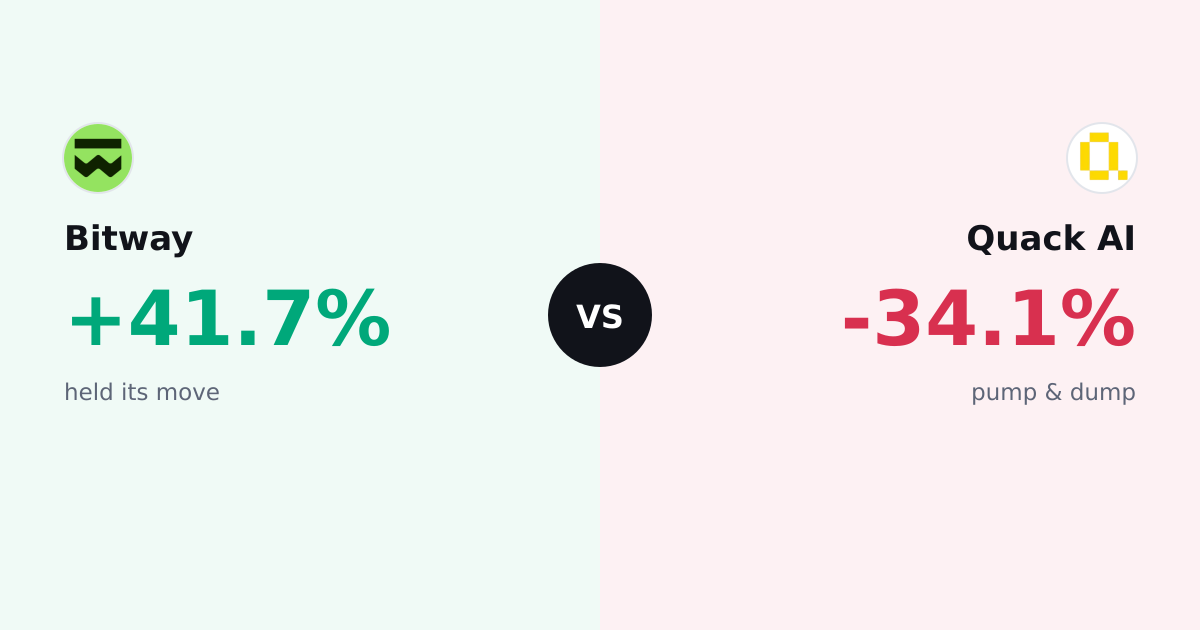
Then it didn't just recover. It reversed hard and kept going, finishing the day up 41.7%.
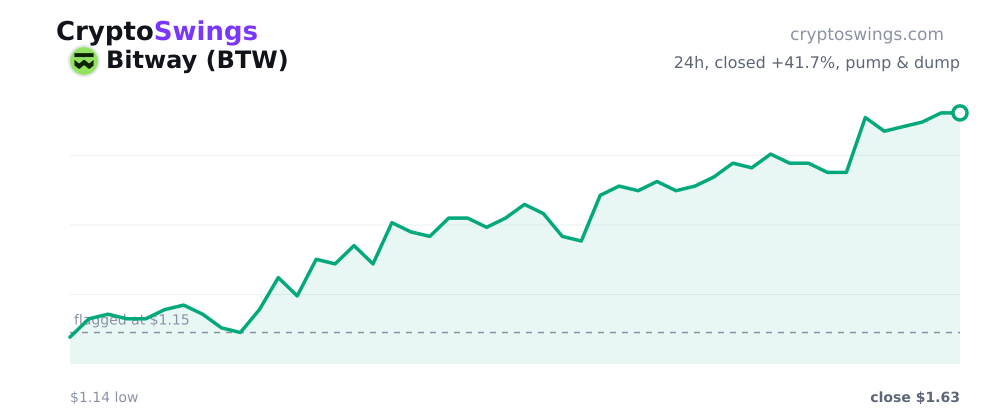
That is a wide swing for a mid-tier coin, and the shape of it matters as much as the size. A slide of that depth that turns into a double-digit gain is not a bounce off a floor. It is a full change of direction, the kind that leaves anyone who sold the early weakness watching the screen with a particular expression.
Here is the twist the dry facts bury: Bitway was tagged as a pump and dump on the day. Usually that label is a warning that the green does not last. This time the green is what stuck, and the early collapse is what turned out to be the head-fake. The market set a trap, then sprang it in the least expected direction.
Quack AI Did the Same Trick, Backwards
Now the other side.
Quack AI started the way everyone wants a coin to start. It was moving up, the detector clocked a swing of 44.4%, and for a stretch it looked like the small-tier name of the day.
It was not.
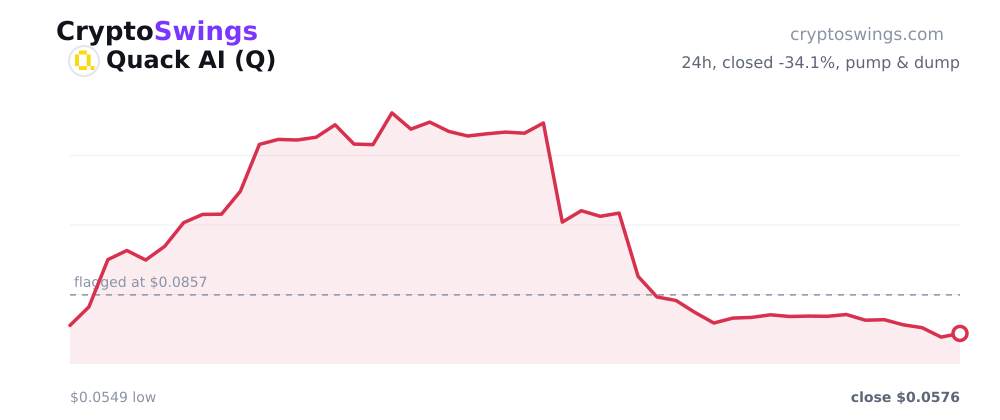
By the close, Quack AI had given all of it back and then some, landing at a loss of 34.1%. The early climb was the whole pitch, and the pitch did not survive contact with the rest of the day. This one earned its pump-and-dump tag the old-fashioned way: it went up, drew eyes, and then sank while people were still admiring it.
Put the two side by side and you get the day in miniature. Bitway's early drop lied to you. Quack AI's early rise lied to you. Both were traps, both reversed, and the reversals ran in opposite directions.
What Actually Separated Them
The honest answer is direction, and direction was not kind to the people who read either coin at face value.
Bitway's bearish early move resolved bullish. Quack AI's bullish early move resolved bearish. Whatever early signal each coin broadcast, the final number mocked it. And according to sentiment data gathered by CryptoSwings, the broader read across the day only landed on the right side about half the time, which is roughly the accuracy of guessing.
Quack AI was not even the biggest headline swing on the board. That belonged to Doodles, which the detector caught moving 66.3% before it settled down 13.4%. But Doodles at least drifted lower in a way that matched its early weakness. Quack AI promised one thing and delivered the opposite, which is a harder kind of day to stomach.
The Shape of October 27
Strip away the tags and the tiers and you are left with a simple, slightly uncomfortable observation.
On October 27, the coin that looked like it was failing was the one you wanted, and the coin that looked like it was winning was the one you did not. Bitway's 41.7% climb and Quack AI's 34.1% slide are mirror images, and the mirror is the lesson. The opening move told you almost nothing about where either coin would finish.
Two coins. One day. They crossed in the middle and never looked back.